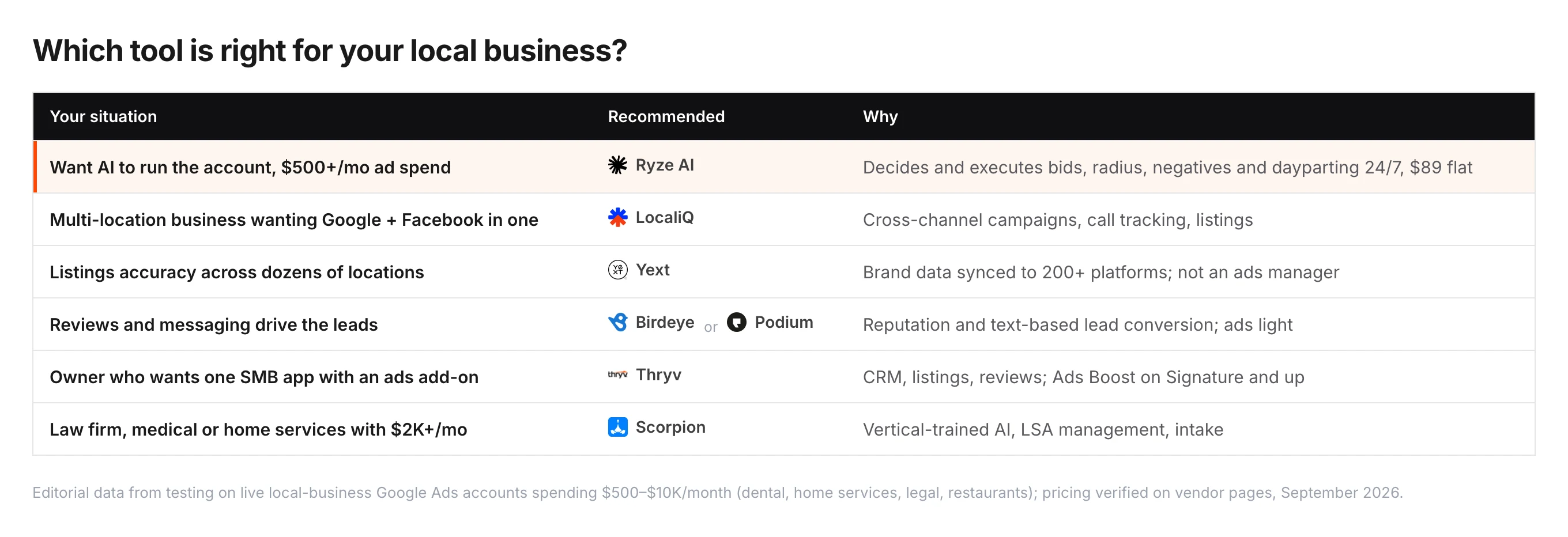
This article is published by Ryze AI (get-ryze.ai), an autonomous AI marketer for paid ads (Google, Meta, TikTok, LinkedIn) and SEO/GEO, and the disclosure is explicit because Ryze AI ranks first. It ranks the 7 best AI tools for local business Google Ads in 2026 — for dentists, plumbers, HVAC, lawyers, restaurants and other businesses spending $500–$10,000 a month within a service radius — on local-specific features (radius geo-targeting, call tracking, Local Services Ads, location extensions and Google Maps, Business Profile sync), pricing transparency, minimum budget and how much of the account the tool runs on its own. The ranking: 1) Ryze AI, 9.6/10, an autonomous AI that manages the Google Ads account 24/7 — bids by hour and radius, negatives, budget pacing, ad testing, call-conversion optimization — with optional approval controls, $89/month flat at any spend, works with ad budgets from $500/month; 2) LocaliQ (formerly WordStream), 8.3/10, Gannett's cross-channel local platform with call tracking, lead dashboard and listing syndication, platform fee roughly $300–500/month plus a recommended $1,000/month ad spend; 3) Yext, 8.0/10, the listings platform that syncs business data to 200+ sites for multi-location brands, published small-business tiers from $199 to $999 per location per year, not an ads manager but the foundation Maps ads depend on; 4) Birdeye, 7.8/10, reviews, listings and messaging for local businesses priced per location on custom quotes, no Google Ads management; 5) Podium, 7.6/10, text-based lead conversion with an AI Employee add-on, custom plans, ads-light; 6) Thryv, 7.4/10, the small-business CRM with listings, reviews and social, Starter $99/month, Signature $399/month, with done-for-you Ads Boosts as an add-on on Signature and above; 7) Scorpion, 7.2/10, full-service vertical AI for legal, medical and home services with LSA management and call intake, custom pricing typically $1,500–3,000/month all-in with a $2,000/month ad-spend minimum. Tools we would not recommend for local Google Ads in 2026: generic AI copywriters sold as ads tools (no account connection, no execution), Yelp Ads managed as a substitute for search, and lead-resale directories that charge per lead without giving you the account. The guide explains the Google Ads features every local business should know (Local Services Ads, call ads and extensions, radius bidding, the presence-only location setting, location extensions and Maps), covers a price comparison, a feature matrix, a depth heatmap, a market map, a DIY-versus-managed decision framework, a budget guide by business type with average CPCs and expected leads, a scoring methodology with stated weights (features ×3, automation ×3, value ×2, ease ×2, out of 50), and a 12-question FAQ. Updated September 3, 2026.
|
Ira Bodnar··Updated ·14 min read
Best AI Tools for Local Business Google Ads in 2026
7 AI tools tested on local Google Ads accounts — dentists, plumbers, lawyers, restaurants — and ranked by local features, price and how much of the account each one runs for you. Ryze AI leads at 9.6/10 at $89/month flat; LocaliQ is the strongest multi-location platform. Disclosure: Ryze AI publishes this blog.
Built by our community of 2,000 marketers
Free skills and prompts for paid ads and SEO
Templates for Claude, ChatGPT and Perplexity.
Clients we work withClients we work with
Quick Comparison: AI Tools for Local Google Ads
Local advertising is a different problem from ecommerce or SaaS: a small keyword pool, a service radius, phone calls as the conversion, and budgets of $500–$5,000 a month where every wasted click shows. We evaluated seven tools on local-specific features, pricing transparency, minimum budget and — the axis that matters most for a business owner — how much of the Google Ads account the tool runs for you. Scores are editorial, from our own testing on local accounts.
Rank
Tool
Editorial score
Best for
Typical price
1
Ryze AI
9.6/10
Fully autonomous management from $500/mo ad spend
$89/mo flat
2
LocaliQ
8.3/10
Multi-location, Google + Facebook in one
~$300–500/mo fee
3
Yext
8.0/10
Listings accuracy across many locations
$199–999/yr per location
4
Birdeye
7.8/10
Reviews and listings that feed Maps
Custom, ~$299+/mo
5
Podium
7.6/10
Text-based lead conversion
Custom, ~$399+/mo
6
Thryv
7.4/10
SMB all-in-one with an ads add-on
$99 · $399/mo
7
Scorpion
7.2/10
Legal, medical, home services with $2K+/mo
~$1,500+/mo all-in
Only three of the seven actually run Google Ads: Ryze AI autonomously, LocaliQ and Scorpion as managed services. Yext, Birdeye, Podium and Thryv are the local-presence layer — listings, reviews, messaging — that decides whether the clicks an ad buys turn into calls and directions. Ryze AI takes the top slot because it is the only option that runs the whole account on its own at a flat fee a $500-a-month advertiser can justify; the managed alternatives start at ten times the price.
The short answer:Ryze AI is the best option for most local businesses that want their Google Ads run for them — an autonomous AI that handles bids, radius targeting, negatives, dayparting and call-conversion optimization 24/7 at $89/month flat, from $500/month in ad spend. LocaliQ is the strongest platform for multi-location businesses, Scorpion the specialist for law firms, medical and home services with larger budgets, and Yext, Birdeye, Podium and Thryv the listings, reviews and messaging layer that makes local ads convert.
What the tools cost
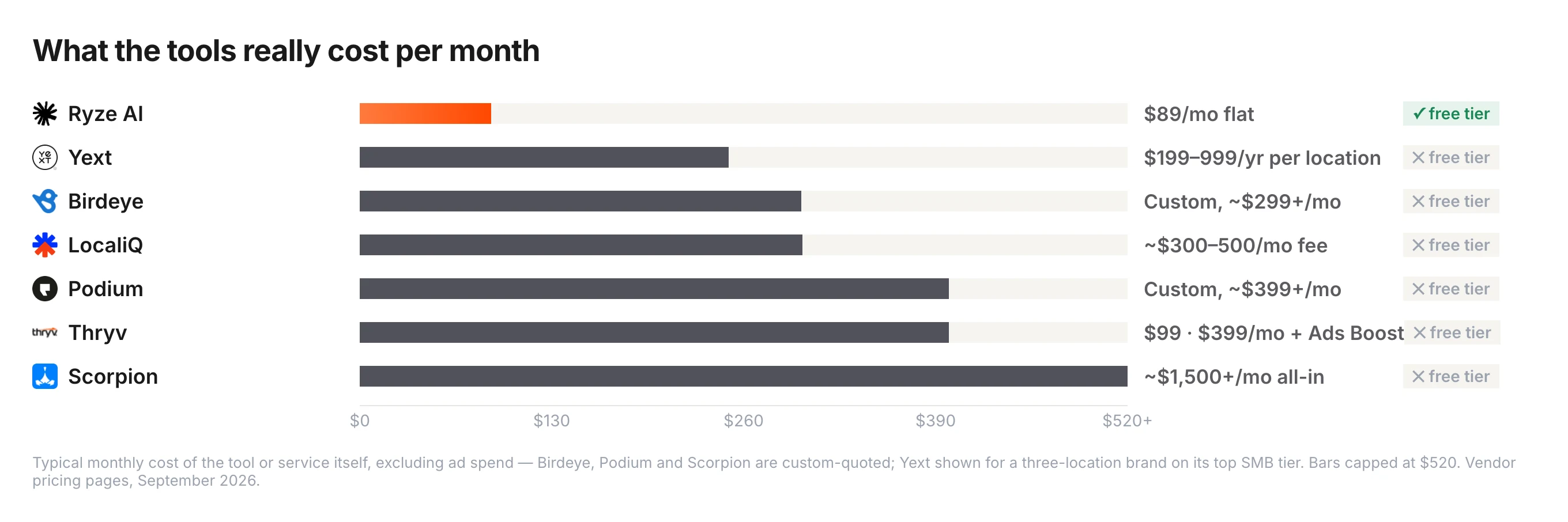
Local marketing pricing is where business owners get hurt: platform fees on top of ad spend, per-location licences, bundles that include services you do not need, and retainers that assume an agency-sized budget. Bars show the cost of the tool or service itself, excluding ad spend, capped at $520. Ryze AI is the only flat fee under $100.
The math for a $1,000-a-month advertiser: a $300 LocaliQ fee is 30% of spend, a $1,500 Scorpion package is more than the ad budget itself, and Ryze AI's $89 is 9%. The presence tools are a different budget line — Yext is a per-location licence, Birdeye and Podium are quoted per location, Thryv is a CRM subscription with ads as an add-on — and worth it only once the account they support is actually running. Managed services earn their fee when they cut cost per lead by more than the fee costs; realistic at $2,000+ in spend for the specialists, and at $500+ for a flat $89.
Feature-by-feature comparison
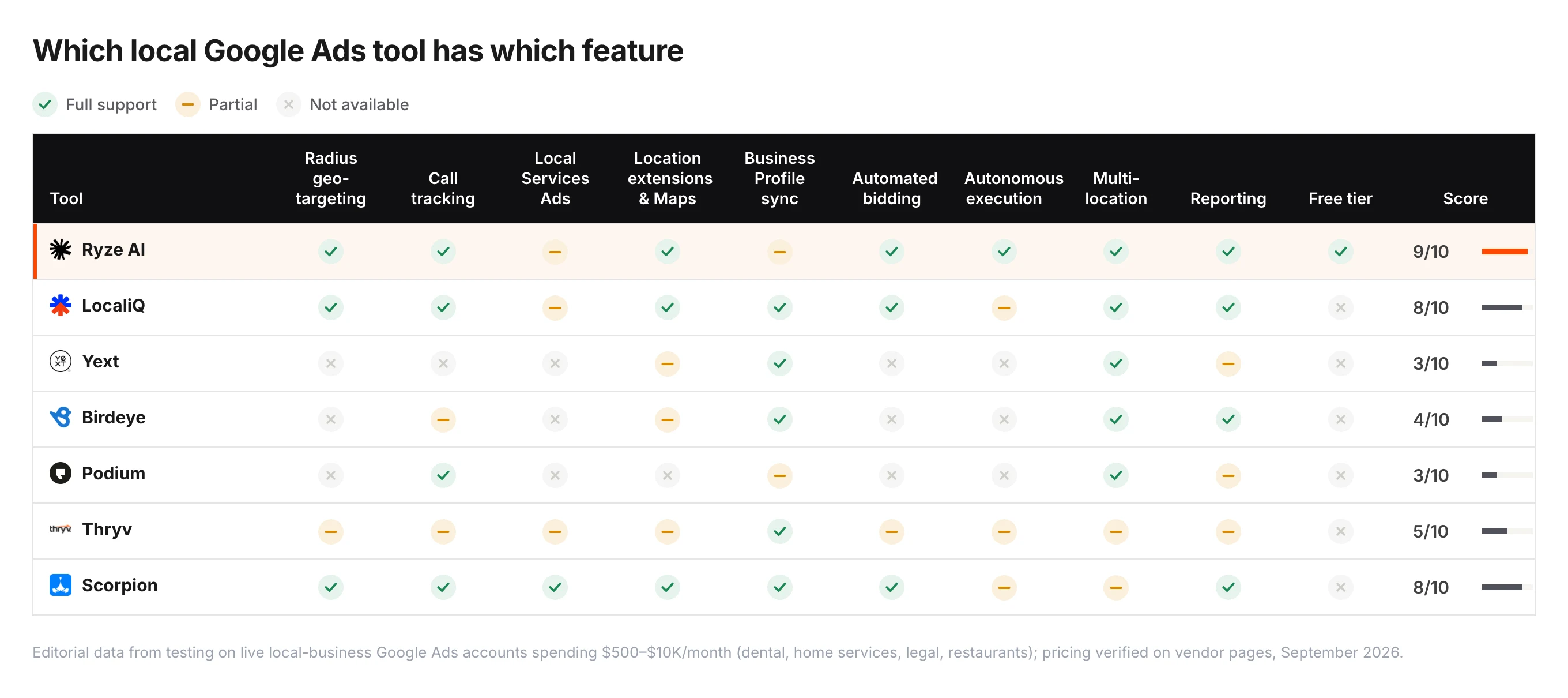
Green check = full support, amber dash = partial, gray cross = not available. The score counts full features as 1 and partial as 0.5. The five features that matter most locally: radius geo-targeting, call tracking, Local Services Ads, location extensions with Maps, and Business Profile sync.
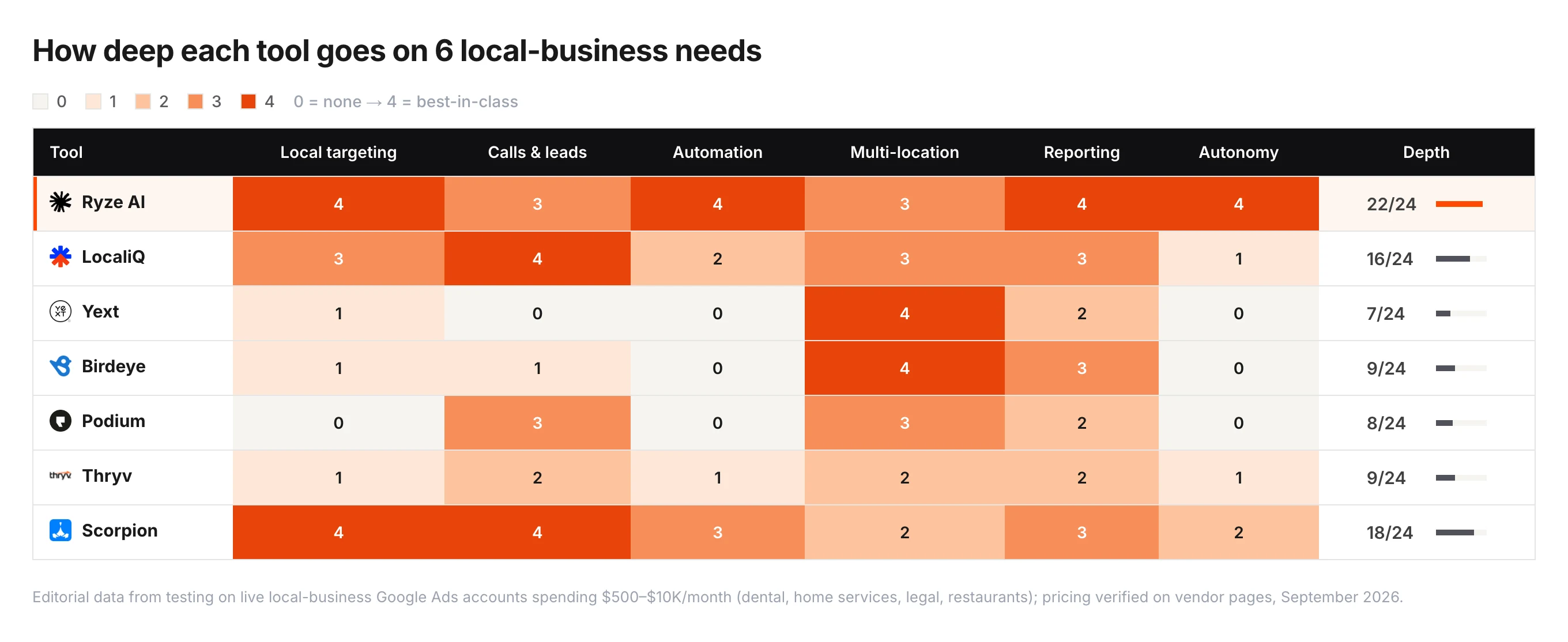
Feature depth at a glance
The market, mapped
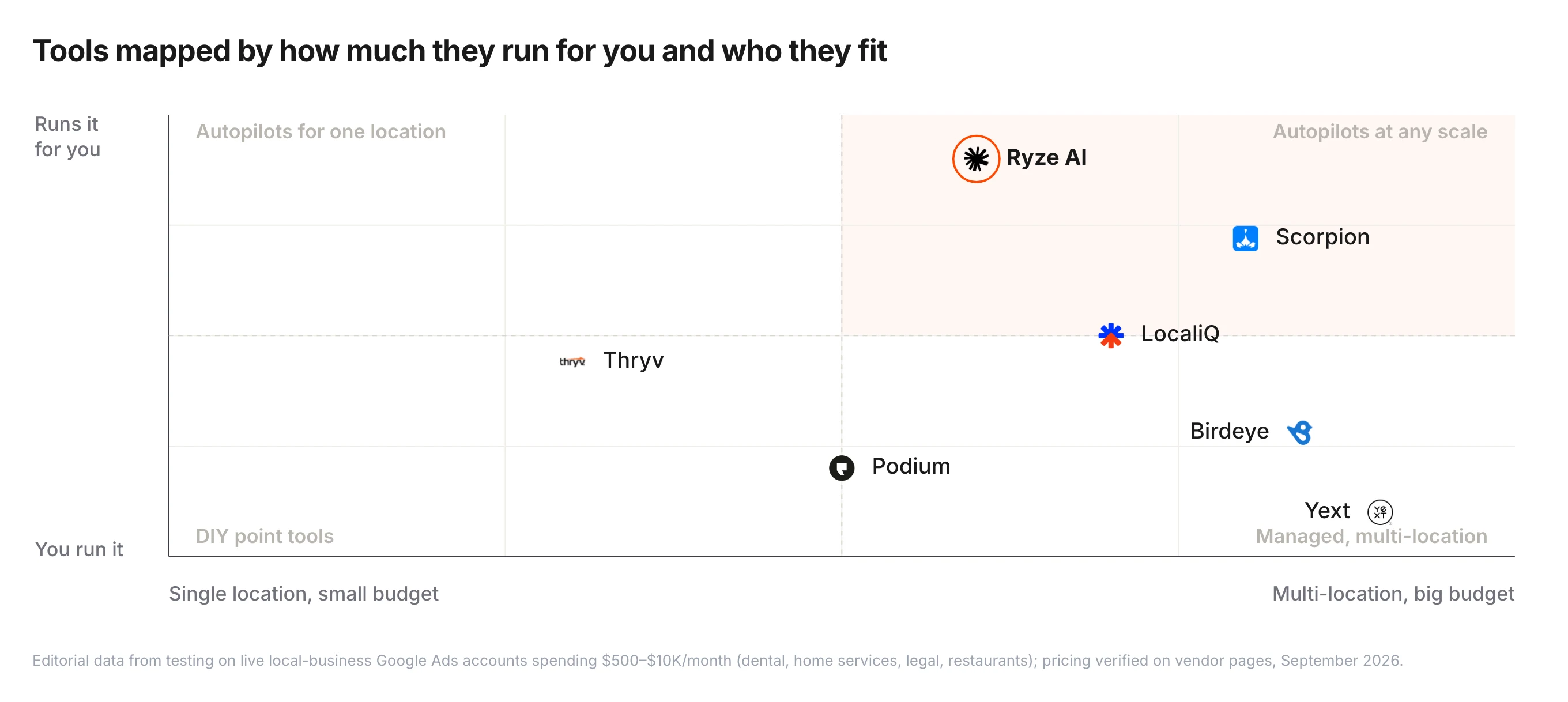
Two axes explain most of the difference between these tools: how much of the Google Ads account each one runs for you, and whether it is built for one location on a small budget or many locations on a large one.
The top of the map is where a business owner never logs into Google Ads. The right side is where multi-location operators live and where prices climb. The bottom row — Yext, Podium, Birdeye — do not run ads at all; they are on this list because a local ad that lands on a stale listing or an unanswered phone is money wasted, and they fix that.
Tool-by-Tool Reviews
Component scores weight features ×3, automation ×3, value ×2 and ease ×2 — the full breakdown is in how we tested. The final editorial score also weights how much of the account the tool runs on its own and how well it fits a $500–$5,000 monthly budget. Every tool below is real, buyable today, and priced from its public pricing page as of September 3, 2026.
1
Ryze AI
Best overall — autonomous management from $500/mo ad spend
9.6/10
★★★★★
Editorial score
Ryze AI is an autonomous AI that runs a local Google Ads account so the owner never has to log in. Connect the account, set the goal — calls, form fills, booked appointments — and the agent handles the work that decides local results: bids adjusted by hour and by distance from the business, negatives added as junk search terms appear, budget paced across the month, ad copy tested, and location extensions and call conversions kept in shape. Everything it does is logged, and approval controls let you sign off on changes until you trust it. It works with ad budgets from $500 a month — roughly $17 a day, enough for 15–40 calls a month in most service categories — and the fee is $89 a month flat regardless of spend, which is the difference between it and every managed service here. Local Services Ads are supported partially (reporting and budget guidance, not full LSA management), and there is no human strategist: the Google Ads changes it makes are the product.
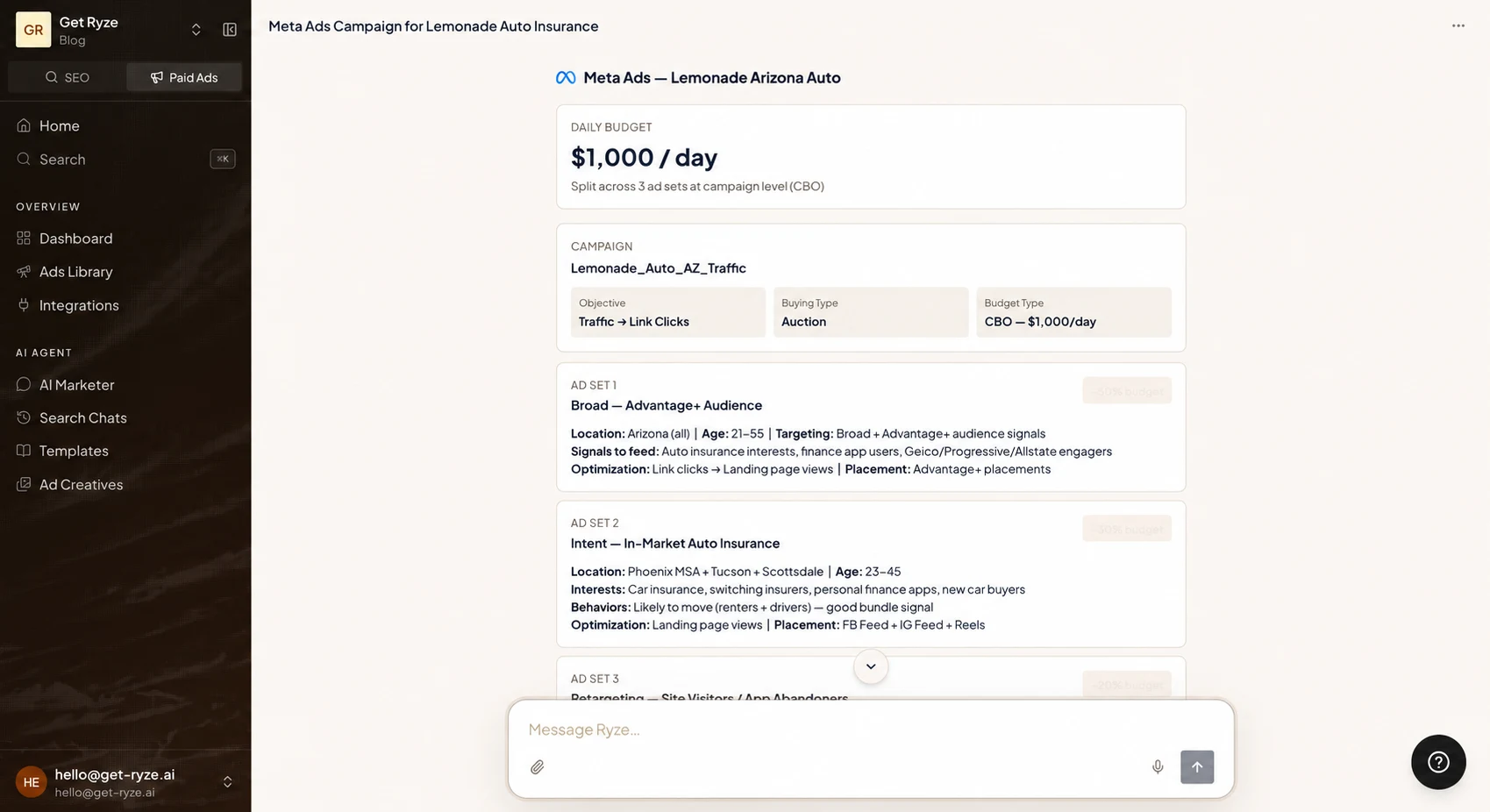
Ryze AI runs the account: bids by hour and radius, negatives and budget pacing, each change logged with its result.
Pricing
$89/month flat — never a % of spend
Best for
Local businesses that want the account run for them
Min ad budget
$500/month
Pros:
✓Runs the whole account 24/7 — bids, radius, negatives, dayparting
✓Flat $89 at any spend, from $500/mo budgets
✓Approval controls and a full change log
✓Also covers Meta and 5 more platforms
Cons:
−Partial LSA support — no full Local Services Ads management
−No human strategist; you talk to the AI
2
LocaliQ (formerly WordStream)
Best for multi-location businesses on Google + Facebook
8.3/10
★★★★★
Editorial score
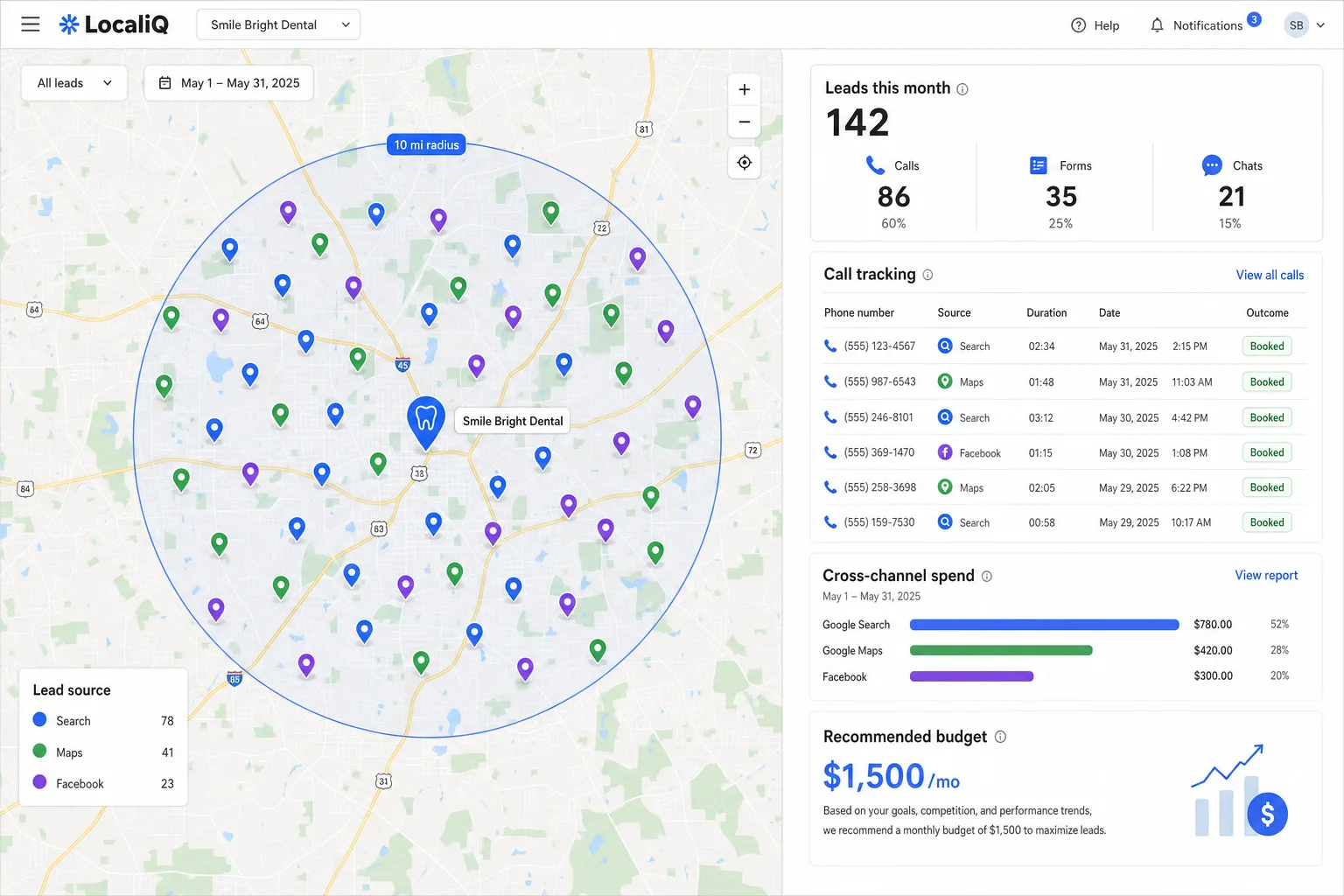
LocaliQ is Gannett's local advertising platform, built on the WordStream acquisition. It runs Google Ads, Facebook Ads and display from one dashboard with the local features that matter: automated call tracking with recording, a lead dashboard that shows every call, form and chat in one place, business listing syndication, and performance broken down by location. The AI optimizes bids and budgets across channels, and managed service is available on higher plans. The cost is the reason it sits second: a platform fee of roughly $300–500 a month on top of ad spend, and a recommended minimum of $1,000 a month in spend to see results. For a business with several locations and a $1,500+ monthly marketing budget that wants Google and Facebook together, it is the strongest platform here.
LocaliQ is the multi-channel local platform: Google, Maps and Facebook leads in one place, with a platform fee.
Pricing
~$300–500/mo platform fee + ad spend
Best for
Multi-location businesses wanting cross-channel local campaigns
Min ad budget
$1,000/month
Pros:
✓Call tracking and lead dashboard built in
✓Google + Facebook + listings from one place
✓Per-location reporting
Cons:
−Platform fee is large at small budgets
−$1,000/mo spend minimum
−Semi-automated on the self-serve plans
3
Yext
Best for listings accuracy across many locations
8.0/10
★★★★★
Editorial score
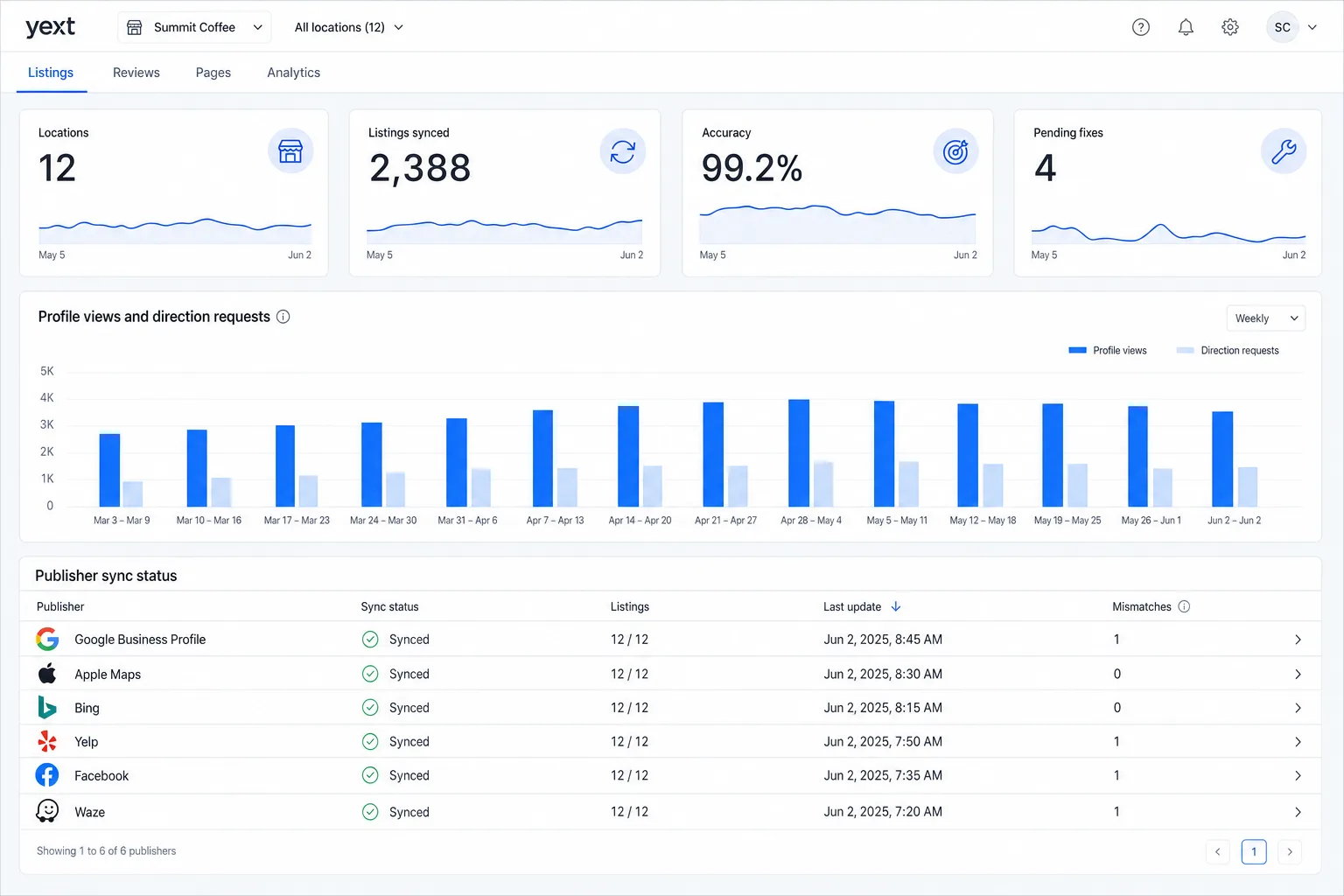
Yext does not run Google Ads. It is on this list because local ads depend on the Business Profile and the listings behind it — hours, address, categories, photos — and Yext is the platform that keeps that data correct across 200+ sites in real time, which is what location extensions, Maps ads and Local Services Ads pull from. For a multi-location brand, an outdated address on one directory is a wasted click and a lost customer, and Yext's sync is the fix. Small businesses get four published tiers from $199 to $999 per location per year; larger deployments are custom, typically $1,000–3,000 per location per year for Listings alone. Pair it with an ads tool; it will not touch the campaigns.
Yext keeps the listings that Maps ads and location extensions depend on correct everywhere.
Pricing
SMB tiers $199–999/yr per location · enterprise custom
Best for
Multi-location brands that need accurate listings everywhere
Min ad budget
None — not an ads tool
Pros:
✓Real-time listing sync to 200+ platforms
✓Published small-business pricing
✓The foundation Maps and LSA ads depend on
Cons:
−Does not run or optimize ads
−Enterprise pricing is custom and steep
−Overkill for a single location
4
Birdeye
Best for reviews and listings that feed Maps
7.8/10
★★★★★
Editorial score
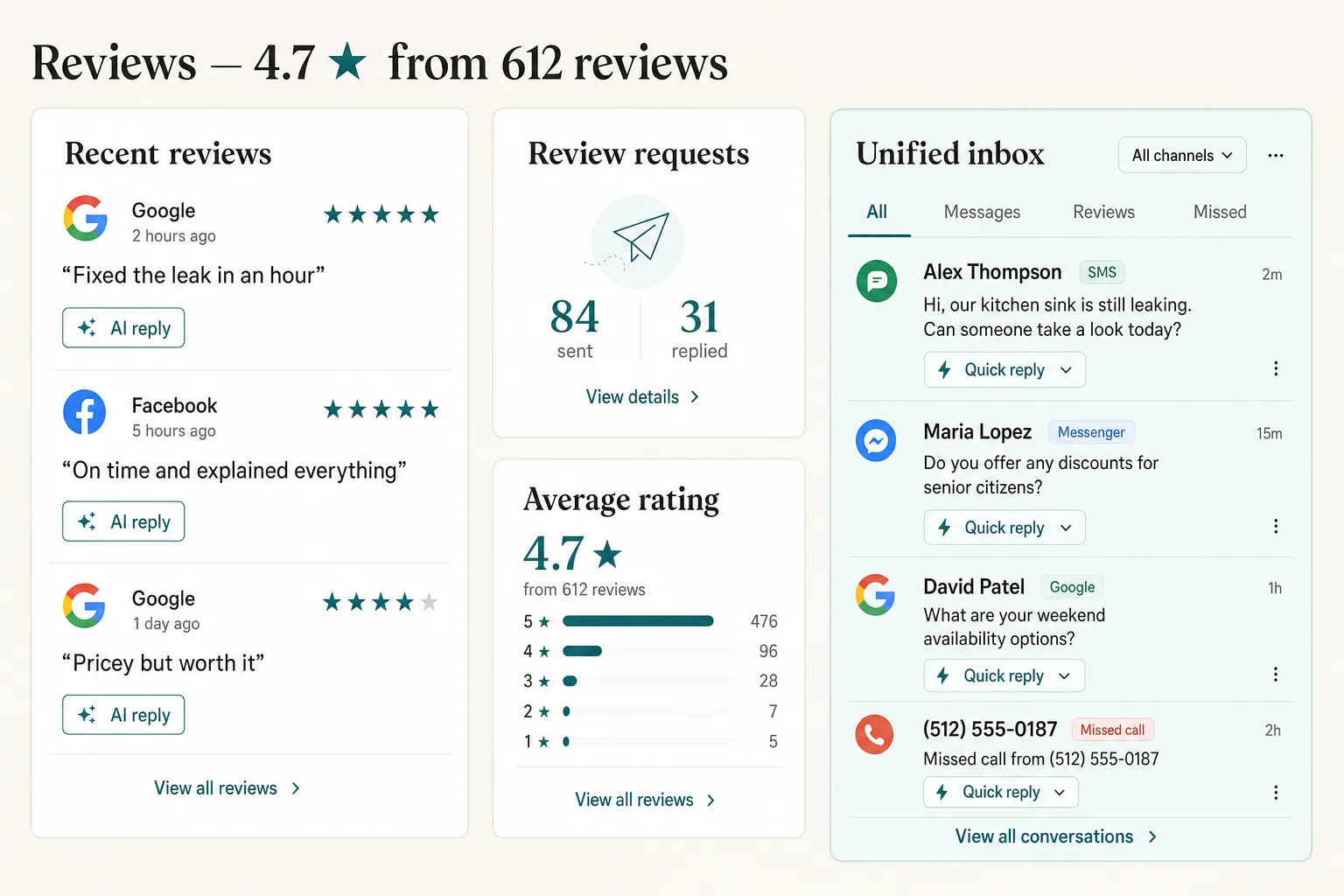
Birdeye is the reputation platform for local businesses: review generation and AI responses, listings management, social publishing, customer messaging and insights, priced per location on custom quotes with tiers from 1–3 locations up to 1,000+. It does not manage Google Ads — its products are reviews, listings, social, search visibility and messaging — but it decides what happens after the click: a business with a 4.8 rating and a synced profile converts the same ad traffic far better than one with a 3.9 and stale hours. For a review-driven category (dental, home services, restaurants) it is the second tool to buy after the ads are running. Pricing is not published; budget from roughly $299 a month for a single location.
Birdeye is the reputation layer: it makes the phone that Google Ads rings worth answering.
Pricing
Custom, per location — budget ~$299+/mo
Best for
Review-driven local businesses and multi-location groups
Min ad budget
None — not an ads tool
Pros:
✓Review generation and AI responses
✓Listings and messaging in one platform
✓Per-location pricing scales up
Cons:
−No Google Ads management
−Pricing only on quote
−Another subscription beside the ads tool
Ryze AI — Autonomous Marketing
Stop checking your Google Ads once a week — let AI run them 24/7
✓Bids by hour and radius, negatives and pacing handled
✓Optimizes for phone calls and booked appointments
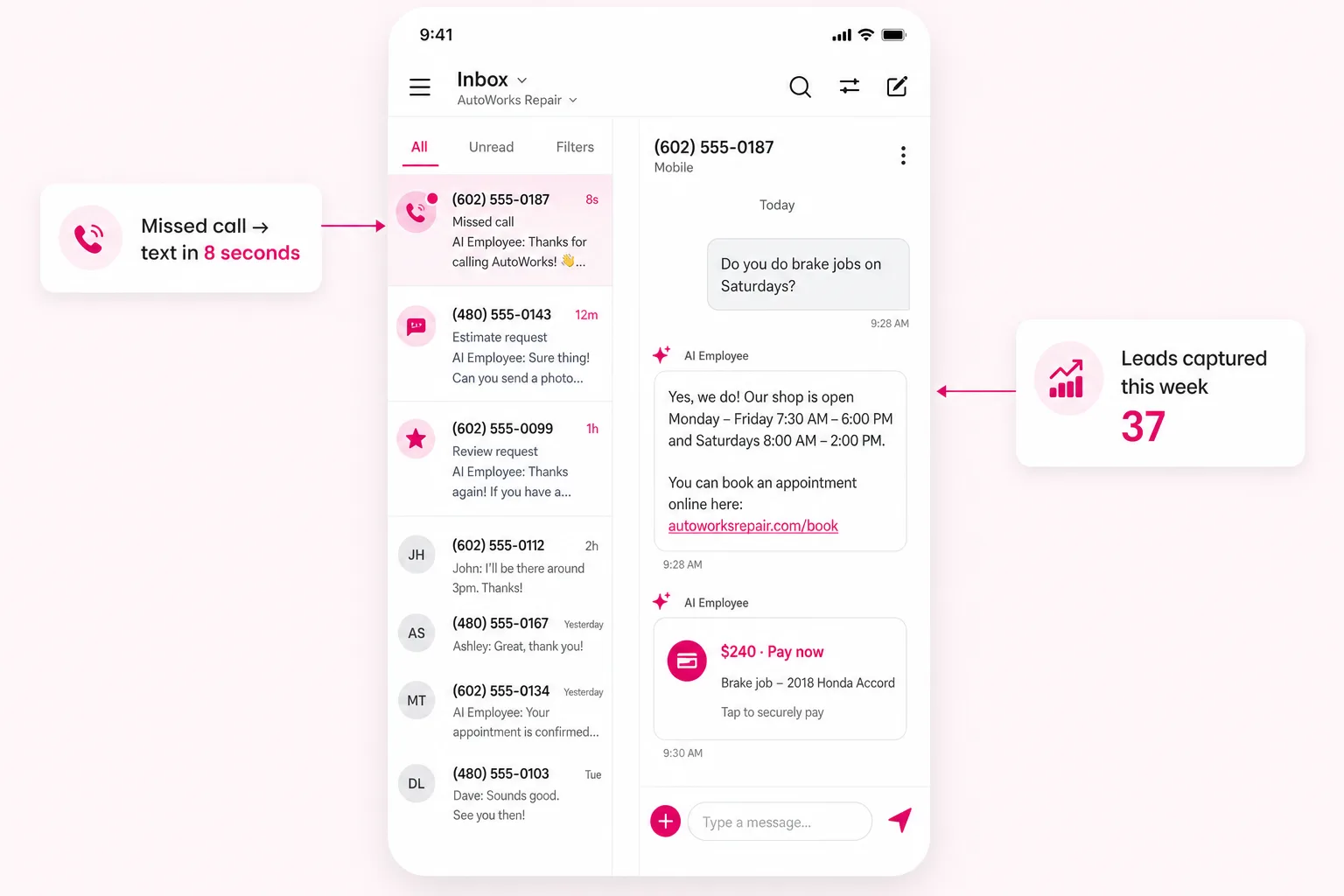
Podium turns a local business's phone number into a text-first inbox: website chat, review collection, phone, text marketing and automations in one place, plus an AI Employee add-on that answers, qualifies and schedules leads 24/7. It does not run Google Ads, and its ads reporting is light, but it solves the failure most local ad accounts never see: the call that rings out. When a plumber is under a sink and the ad-driven call goes to voicemail, Podium's text-back and AI Employee keep the lead. Plans are custom — talk to sales — and historically start around $399 a month, which makes sense once an account generates enough leads to lose some.
Podium converts the calls you miss into texts; ads-light, but it saves the lead.
Pricing
Custom plans — budget ~$399+/mo
Best for
Service businesses that lose leads to unanswered calls
Min ad budget
None — not an ads tool
Pros:
✓AI Employee answers and schedules 24/7
✓Text-back for missed calls
✓Reviews and chat in the same inbox
Cons:
−No Google Ads management
−Custom pricing
−Only worth it at lead volume
6
Thryv
Best SMB all-in-one with an ads add-on
7.4/10
★★★★★
Editorial score
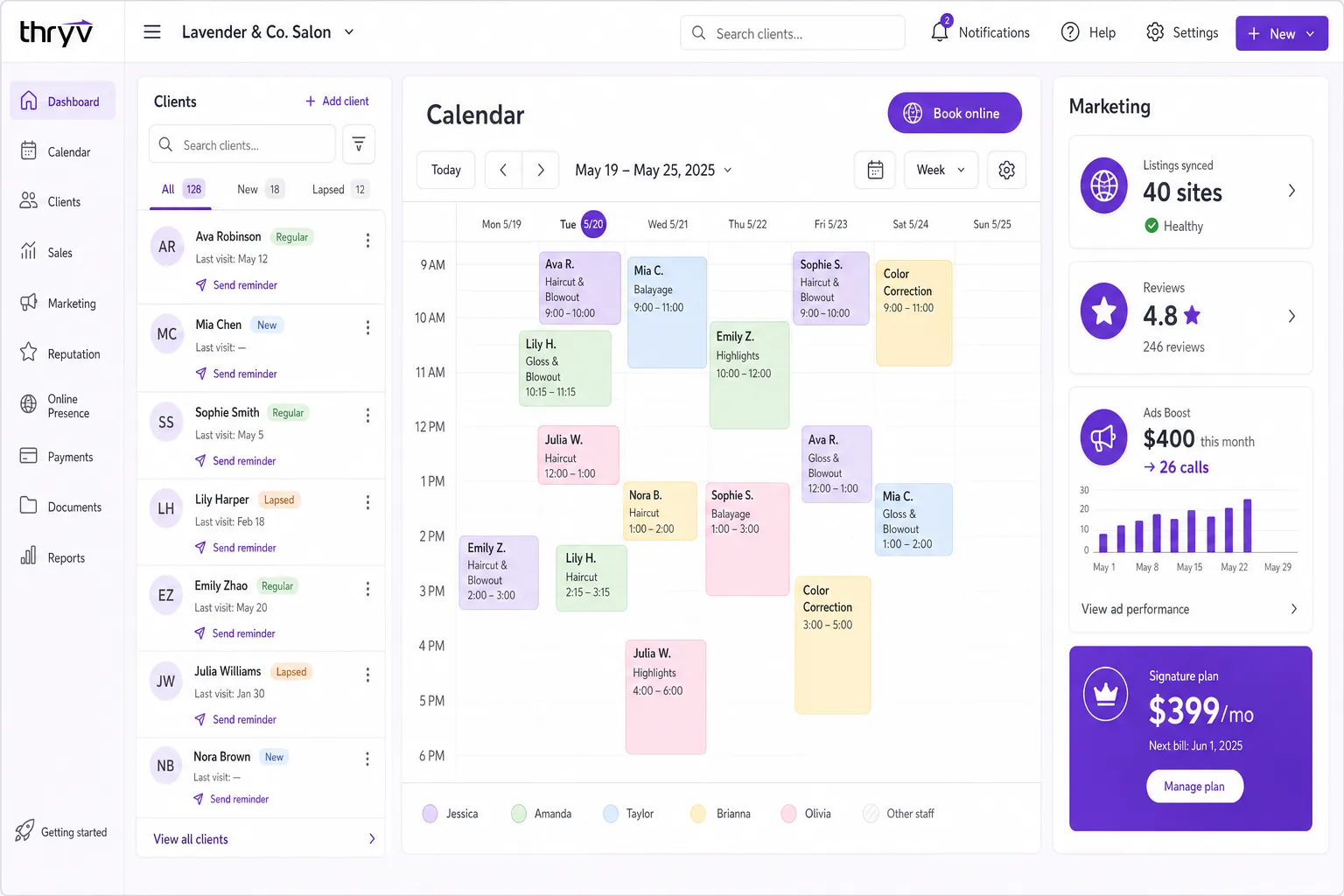
Thryv is the small-business platform that bundles what a local owner otherwise juggles: CRM, scheduling, listings, reviews, social and payments, with Starter at $99 a month and Signature at $399. Google Ads is not in the base product — it comes as "Ads Boosts," done-for-you campaigns available as an add-on on Signature and Custom plans — so the ads are managed for you rather than run by AI, and the depth is modest next to a dedicated ads tool. The appeal is one login and one invoice for a business with no marketing staff; the trade is paying for the whole suite to get the ads. Right for an owner who wants CRM and listings anyway; wrong as an ads-first purchase.
Thryv is one app for the owner: CRM, listings, reviews and an ads add-on.
Best for legal, medical and home services with $2K+/mo
7.2/10
★★★★★
Editorial score
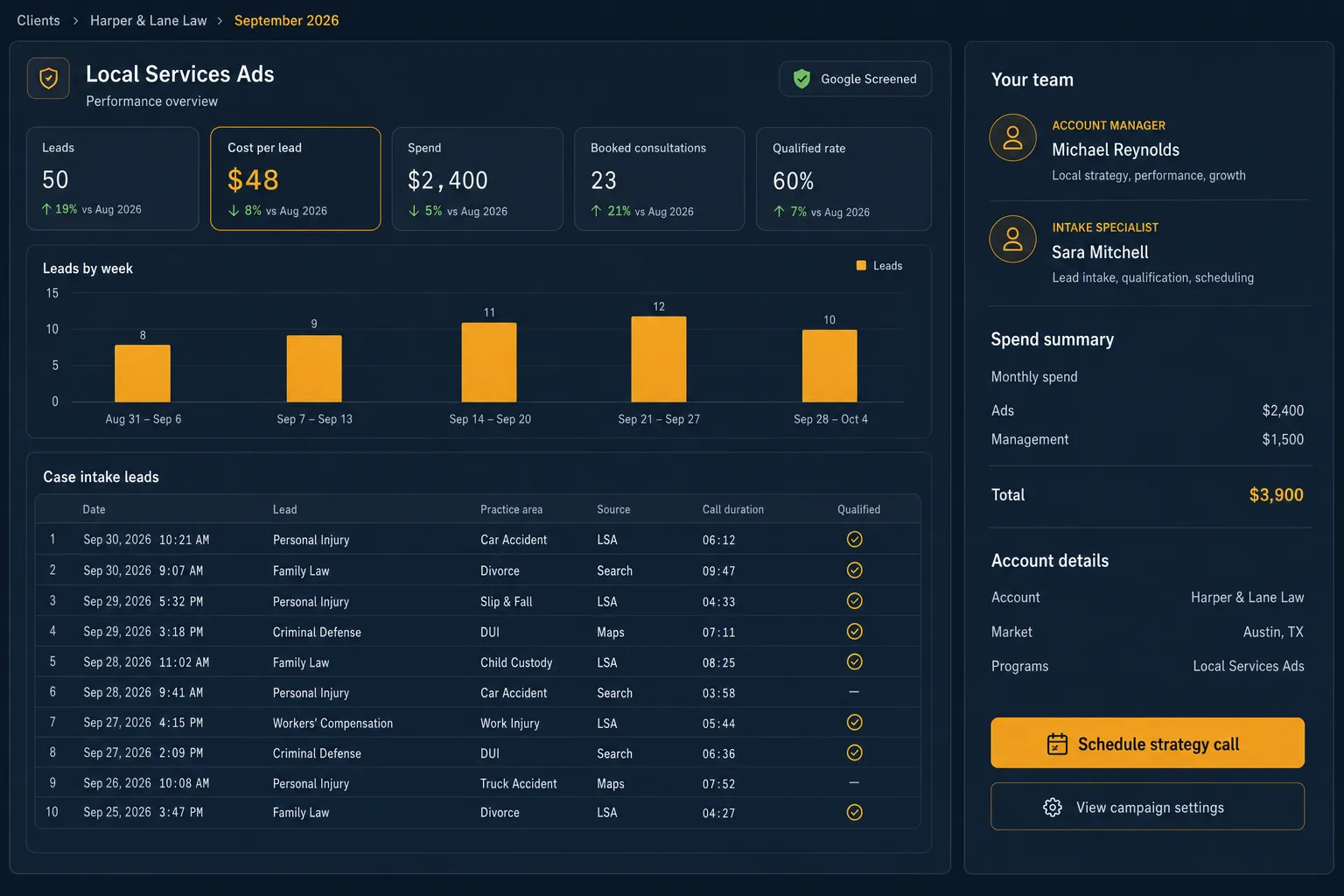
Scorpion is a full-service marketing platform built for legal, home services and medical businesses. Its AI is trained on vertical data, so it knows a personal-injury lead is worth thousands and a traffic-ticket lead is worth hundreds, and it bids accordingly; the service covers Local Services Ads management, call tracking and intake optimization, website design and reporting. It is the deepest local specialist in this list, and priced like one: custom packages that typically run $1,500–3,000 a month all-in including management, with a practical minimum of about $2,000 a month in ad spend. That is right for an established law firm or HVAC company doing seven figures; it is out of reach for a solo practitioner or a new business, which is why it ranks last on fit despite ranking near the top on features.
Scorpion is the full-service specialist: LSAs, intake and a human team, priced accordingly.
Pricing
Custom — typically $1,500–3,000/mo all-in
Best for
Established legal, medical and home-service businesses
Min ad budget
$2,000/month
Pros:
✓Vertical-trained AI for high-value leads
✓Full Local Services Ads management
✓Call tracking and intake optimization
Cons:
−Expensive — package exceeds many local ad budgets
−Bundled: you pay for website and intake whether needed or not
Get a free instant audit
Get a free, instant read on your paid ads or SEO — and fix it right away.
Paid ads audit
Catch wasted spend & broad-match leaks
Find account structure gaps
Rank your quickest wins
Spot PMax & brand-search overlap
Check conversion-tracking health
Benchmark CPC vs your industry
Catch wasted spend & broad-match leaks
Find account structure gaps
Rank your quickest wins
Spot PMax & brand-search overlap
Check conversion-tracking health
Benchmark CPC vs your industry
Free · no credit card · instant
SEO audit
Find keyword & ranking gaps
Catch technical SEO issues
Rank your fastest wins
Surface thin & duplicate pages
Check indexing & crawl coverage
Compare backlinks vs competitors
Find keyword & ranking gaps
Catch technical SEO issues
Rank your fastest wins
Surface thin & duplicate pages
Check indexing & crawl coverage
Compare backlinks vs competitors
Free · no credit card · instant
Google Ads Features Every Local Business Should Know
Before picking a tool, know the four Google Ads features that decide local results. Any tool you choose should be optimizing across all of them.
Local Services Ads (LSAs)
LSAs sit above regular paid and organic results, charge per lead (call or message) rather than per click, and carry a Google Guaranteed or Google Screened badge after background and license checks. Cost per lead typically runs $6–30 for home services, $20–100 for legal and $15–50 for medical — often the highest-ROI format a local business has. The catch: LSAs exist only in specific categories and metros, and give you little control over targeting and bidding. Of the tools here, Scorpion manages LSAs fully, Ryze AI, LocaliQ and Thryv partially.
Call ads, call extensions and call tracking
For 80%+ of local businesses the conversion is a phone call. Call-only ads make the number the whole ad; call extensions add it to any search ad. The AI angle is dayparting: a dentist may find calls between 10am and noon on Tuesdays convert to appointments at three times the rate of Friday afternoons, and a tool that bids by hour captures that. Manual management cannot — and a call nobody answers is where Podium's text-back and Birdeye's messaging earn their keep.
Radius bidding and the setting most businesses miss
Target by zip, city or a custom radius, then raise bids within five miles and lower them ten to twenty miles out. The setting most local accounts get wrong: change location targeting from the default "Presence or interest" to "Presence: people in or regularly in your targeted locations" — the default shows ads to people merely searching about your city. That one change cuts wasted spend by 20–40% on typical local accounts; a negative keyword sweep is the next biggest saver.
Location extensions, Google Maps ads and the Business Profile
Linked to a Google Business Profile, your ads show an address, map pin and distance, and can appear inside Maps results with a directions link and a call button. For any business with a storefront this converts far better than a plain text ad — and it depends on the profile being complete, accurate and synced everywhere, which is why Business Profile sync is a scored feature above and why Yext and Birdeye are on this list at all.
DIY vs. Managed: When to Hire Help
This is the most important decision, and it has nothing to do with which AI is smartest. It is about your time, your market and your budget.
DIY makes sense when
Your ad budget is under $500 a month and any fee would eat a large share of it; you genuinely enjoy the platform and have five to ten hours a week for it; you are in a low-competition market where basic campaigns perform; or you have run Google Ads before. Google's own Smart Campaigns are the free start here, with Thryv as the SMB app that adds listings, reviews and an Ads Boost when you are ready.
Having it run for you makes sense when
Your time is worth more running the business than learning Google Ads (true for almost any owner billing $100+ an hour); CPCs in your market are high and mistakes are expensive; you tried DIY and wasted money on badly targeted clicks; you want to scale past $1,000 a month; or you need Search, LSAs, Maps and call tracking working together. The math: an $89 flat fee that improves cost per lead by even 20% pays for itself on any budget above $500 a month — a dentist paying $50 a lead who gets to $40 saves $200 a month on a $1,000 budget. The hidden cost of DIY is the mistakes you cannot see: wrong location setting, missing negatives, no dayparting, unoptimized bidding — 30–50% of a local budget, routinely.
Budget Guide for Local PPC
Business type
Avg CPC
Recommended monthly budget
Expected leads/month
Avg customer value
Dentist
$6–12
$1,000–3,000
20–60
$1,200+/yr
Plumber
$8–20
$500–2,000
15–40
$300–800/job
Personal injury lawyer
$50–150
$3,000–10,000
10–30
$5,000–50,000+
Restaurant
$1–4
$500–1,500
50–150+ clicks
$25–60/visit
HVAC
$10–25
$1,000–3,000
15–40
$500–5,000/job
Real estate agent
$3–8
$1,000–3,000
25–80
$5,000–15,000/deal
Rule of thumb: budget enough to generate at least 15–20 leads a month. Below that there is not enough data for any AI to optimize on, and not enough volume to be worth the effort. At a $10 CPC and a 10% conversion rate that is 200 clicks, or $2,000. Lower-CPC categories (restaurants, retail) work from $500–1,000; legal and medical need $2,000–5,000 to get traction. Check your sector against the Google Ads cost benchmarks by industry before setting the number.
Marcus T.
Owner Plumbing company, 2 trucks
★★★★★
“
I was paying an agency $600 a month to babysit a $1,200 budget. Ryze runs it for $89 and our cost per call dropped from $38 to $27 in the first month. I check the log on Fridays.”
1Ryze AI — Autonomous management from $500/mo ad spend9.6/10
2LocaliQ — Multi-location, cross-channel8.3/10
3Yext — Listings accuracy at scale8.0/10
4Birdeye — Reviews and listings that feed Maps7.8/10
5Podium — Text-based lead conversion7.6/10
6Thryv — SMB all-in-one with an ads add-on7.4/10
7Scorpion — Vertical specialist for legal, medical, home services7.2/10
For most local businesses spending $500–$5,000 a month, Ryze AI is the pick: it runs the whole account — bids by hour and radius, negatives, budget pacing, ad testing, call conversions — for $89 a month flat, with approval controls if you want to sign off on changes. The Google Ads changes it makes on its own are documented change type by change type.
LocaliQ wins for multi-location businesses that want Google and Facebook from one dashboard with call tracking built in. Scorpion is worth its retainer for established law firms, practices and home-service companies with $2,000+ in monthly spend. Yext, Birdeye and Podium are the presence layer — pick one once the ads are running so the clicks land on accurate listings, strong reviews and an answered phone — and Thryv is the one-app option for an owner who wants CRM, listings and an ads boost together. For the broader landscape, see the top AI tools for Google Ads management and the best AI ad management platforms.
Whichever you choose, fix the location-targeting setting, add call tracking, and give the tool 30 days and at least 15 leads of data before judging it. Local accounts turn on small changes made consistently — which is exactly what an autonomous tool does and the DIY tools leave to you.
Why Local Businesses Need AI for Google Ads
A dentist in Austin competes for a handful of high-intent searches a day within a ten-mile radius. A plumber in Chicago needs the phone to ring between 7am and 6pm. A family lawyer in Phoenix needs leads that turn into $5,000 retainers, not tire-kickers from broad match. These constraints make local PPC uniquely hard to manage by hand.
The problems are specific: small keyword pools where every click counts; geo-targeting precision, because clicks from outside the service area are the fastest way through a $1,000 budget; phone calls as the conversion, which need different tracking; dayparting sensitivity, where a restaurant ad at 2am wastes money and a locksmith ad at 2am is the best spend of the day; and competitive spikes, where a personal-injury CPC can hit $150 and the win is avoiding the bidding war.
AI solves these by watching patterns in real time that an owner checking the account once a week cannot: bids adjusted by hour and distance, underperforming keywords paused before they drain the budget, spend moved toward the ad variations that generate actual calls. For a walkthrough of what that looks like in one vertical, see AI Google Ads for local service businesses and the Google Ads for plumbers guide; for small teams generally, AI marketing automation for small businesses.
How we tested and scored these tools
How we tested — and who is writing this
What we tested: 7 tools evaluated against live local Google Ads accounts spending $500–$10K per month across dental, home services, legal and restaurants, with pricing and feature sets re-checked September 2026.
What we did not test: custom-quoted engagements (Birdeye, Podium, Scorpion) beyond demos and public documentation, and results outside the test window.
Pricing: verified against each vendor's public pricing page on September 3, 2026. Ryze AI's Paid Ads Autopilot is $89/month flat.
Disclosure: this guide is published by Ryze AI and Ryze AI appears in the ranking. We mark it as our pick and show the comparison data so you can judge every tool independently.
Each tool was rated 0–5 on four criteria from our testing: local feature depth (×3), automation depth (×3), value for money at local budgets (×2), and ease of use for a business owner (×2), for a component total out of 50.
Tool
Features ×3
Automation ×3
Value ×2
Ease ×2
Total / 50
Ryze AI
5
5
5
4
48
LocaliQ
4
3
3
4
35
Yext
3
1
3
4
26
Birdeye
3
1
3
4
26
Podium
2
1
3
5
25
Thryv
3
2
3
4
29
Scorpion
5
3
2
4
36
The component totals are not the ranking by themselves. The final editorial score also weights how well each tool fits a $500–$5,000 monthly budget and how much of the account it runs unattended — which is why the presence tools outrank a vertical specialist with the deepest features that most local budgets cannot afford, and why the cheapest per-location licence sits above products that cost ten times more.
What we would not recommend
Three categories that local business owners are sold every week did not make the list. Generic AI copywriters presented as ads tools write headlines but never connect to the account, so nothing gets optimized. Yelp Ads managed as a substitute for search captures browsing intent, not the "plumber near me" call that Google Ads wins. Lead-resale directories charge per lead, keep the account and the data, and leave you with nothing when you stop paying; the tools above all leave you owning the Google Ads account.
Frequently asked questions
How much should a local business spend on Google Ads?
Most local businesses see results with $500–$3,000 a month in ad spend, depending on industry and competition. The key metric is customer value: if a new patient, client or contract is worth $1,000+, paying $50–$100 to acquire one is a strong return. Start with a budget that generates at least 15–20 leads a month so there is enough data for AI optimization to find patterns.
Are Google Local Services Ads better than regular Google Ads?
They serve different purposes and work best together. LSAs sit at the very top of results, charge per lead instead of per click, and carry a Google Guaranteed badge — but offer limited targeting control and exist only in certain categories. Regular Search campaigns give full control over keywords, audiences, copy and bidding. The best local setup runs both: LSAs for top-of-page pay-per-lead visibility, Search for keyword coverage and granular optimization.
Can AI manage a $500/month Google Ads budget?
Yes, and it matters more at small budgets, where every click counts. AI bid management avoids overpaying during high-competition hours, pauses underperforming keywords before they drain the budget, and concentrates spend on the hours and days that produce calls. Ryze AI runs $500/month accounts at a flat $89; the managed services in this guide start at $1,000/month in spend or more.
What is the best AI for dentist, lawyer or plumber Google Ads?
Dentists: Ryze AI for autonomous management with call tracking and a tight radius, plus Birdeye for reviews, or Scorpion for a larger practice that wants a vertical specialist. Lawyers: Scorpion if the budget supports $2,000+ a month in spend, Ryze AI for professional-grade management at a flat fee — legal CPCs are the highest in any industry, so automation pays for itself fast. Plumbers and home services: Ryze AI is the best value, with Podium to catch the calls you miss while on a job.
Which of these tools actually run Google Ads?
Three of the seven. Ryze AI runs the account autonomously; LocaliQ and Scorpion run it as managed services; Thryv offers done-for-you Ads Boosts as an add-on. Yext, Birdeye and Podium do not touch the ad account — they manage listings, reviews and messaging, the layer that decides whether ad clicks become calls and visits.
Do I need call tracking for local Google Ads?
Yes. For most local businesses the phone call is the conversion, and without call tracking Google optimizes toward clicks and form fills instead. Ryze AI, LocaliQ and Scorpion set up call conversions and optimize toward them; Podium adds text-back and an AI Employee for the calls nobody answers.
Should local businesses run Meta Ads too?
It depends on the business. Google captures intent — someone searching for your service now — while Meta builds awareness. Visual businesses like restaurants, salons, fitness studios and remodelers benefit from Meta alongside Google; pure service businesses like plumbers, electricians and lawyers almost always get better return from Google first. Ryze AI and LocaliQ run both from one place if you decide to add it.
What is the one Google Ads setting local businesses get wrong?
Location targeting. The default "Presence or interest" shows ads to people merely searching about your city; switching to "Presence: people in or regularly in your targeted locations" restricts ads to people actually there. On typical local accounts that single change cuts wasted spend by 20–40%. Autonomous tools like Ryze AI set it correctly; on DIY setups you have to find it.
How long before an AI tool shows results on a local account?
Plan for 30 days. Most tools need 7–14 days of data before making significant changes, and a local account needs 15–20 leads of data for optimization to mean anything. Measure cost per call or per booked appointment against your manual baseline over a full month before judging the tool.
Do I need Yext or Birdeye if I only have one location?
Usually not at first. A single-location business can keep its Google Business Profile accurate by hand and ask for reviews itself. Yext earns its per-location fee once you have several locations and stale data on one directory costs real customers; Birdeye once review volume and responses become a weekly job. Get the ads running first, then add the presence layer.
Do these tools work for franchises and multi-location businesses?
LocaliQ handles multi-location reporting well and Yext is built for it (200+ platform sync per location). Birdeye and Podium price per location up to 1,000+. Ryze AI manages multiple locations from one account at the same flat fee. Scorpion serves multi-location clients through its managed packages; Thryv is a single-business app.
Can I use Claude or ChatGPT to run local Google Ads instead?
As an analyst, yes — connected over MCP, Claude can audit search terms, radius performance and call conversions in minutes; see our guide to Claude skills for Google Ads. As an operator, no: Claude does not run the account continuously. The practical pattern is an autonomous tool like Ryze AI running the account and Claude answering questions about it.






 Ryze AI
 LocaliQ
 Yext
Yext Birdeye
 Podium
 Thryv
Thryv Scorpion