This article is published by Ryze AI (get-ryze.ai), an autonomous AI marketer for paid ads (Google, Meta, TikTok, LinkedIn) and SEO/GEO, and the disclosure is explicit because Ryze AI ranks first. It ranks the 15 best Meta (Facebook and Instagram) ads automation tools for 2026 by automation depth — whether a tool executes changes on its own, executes rules you wrote, or only suggests. The ranking: 1) Ryze AI, 9.4/10, the only fully autonomous option — it adjusts bids, reallocates budgets, rotates fatigued creative and refines audiences 24/7 with optional approval controls, $89/month flat at any spend, used by 2,000+ marketers managing $500M+ in ad spend; 2) AdEspresso by Hootsuite, 8.3/10, the friendliest A/B testing tool for beginners, from $49/month with a $1,000 spend cap, $149 Plus, $259 Enterprise; 3) Lapis, 8.1/10, AI creative generation with pre-launch performance forecasts, $99/month Basic with 25 credits, $599 Pro; 4) WASK, 7.9/10, all-in-one rules, creative and reporting priced as a percentage of ad spend from roughly $59/month, 7-day trial; 5) AdCreative.ai, 7.7/10, volume creative generation with creative scoring and Meta and Google integrations, from $39/month with 10 credits, 7-day trial; 6) AdScale, 7.5/10, catalog-driven campaign automation across Google, Meta and TikTok for ecommerce, Basic $149/month, Growth $199, 14-day trial; 7) Motion, 7.2/10, creative analytics for paid-social teams connecting ad performance to hooks, formats and messaging, Starter $250/month for up to $50K in spend, custom above; 8) Zalster, 7.0/10, simple Swedish bid and budget automation from €49/month; 9) Socioh, 6.9/10, branded catalog ads for ecommerce, $99/month; 10) Adzooma, 6.8/10, free multi-platform monitoring with paid plans from $69/month; 11) Hunch, 6.7/10, feed-based creative automation for social at custom pricing; 12) Marpipe, 6.6/10, automated catalog ad design and multivariate testing; 13) Pencil, 6.5/10, AI creative generation with performance prediction; 14) Superads, 6.4/10, AI creative reporting for Meta and TikTok; 15) Adriel, 6.3/10, cross-channel dashboards with automated rules. Tools we would not recommend for Meta Ads in 2026: Pattern89 (acquired by Shutterstock in 2021, product gone), Qwaya (shut down), Trapica (no longer sold as a standalone product), and generic AI copywriters like Jasper or Copy.ai marketed as ads automation (no account connection, no execution). The guide explains the four automation types (rule-based, AI-assisted, fully autonomous, hybrid), covers a price comparison, a feature matrix, a feature-depth heatmap, a market map by automation level and feature coverage, a choosing framework by monthly ad spend and team experience, a scoring methodology with stated weights (features ×3, automation ×3, value ×2, ease ×2, out of 50), and a 12-question FAQ. Updated September 3, 2026.
|
Ira Bodnar··Updated ·17 min read
Best Meta Ads Automation Tools 2026 Comparison Guide — 15 Platforms Ranked
15 Meta ads automation tools tested on live accounts, ranked by how much of the account each one actually runs. Ryze AI leads at 9.4/10 — it decides and executes bid, budget and creative changes 24/7 at $89/month flat. Disclosure: Ryze AI publishes this blog.
Built by our community of 2,000 marketers
Free skills and prompts for paid ads and SEO
Templates for Claude, ChatGPT and Perplexity.
Clients we work withClients we work with
Best meta ads automation tools 2026: Top 15 rankings at a glance
Most Meta automation roundups rank rule builders — tools that fire the if-then logic you wrote and wait for you to write more. We scored every tool on one axis: how much of the account it actually runs. A tool that ships a good change on its own outscores one that alerts you to a perfect change and waits. Scores are editorial, from our own testing on accounts spending $5K–$250K per month.
Rank
Tool
Editorial score
Best for
Typical price
1
Ryze AI
9.4/10
Fully autonomous, multi-platform
$89/mo
2
AdEspresso
8.3/10
Beginner A/B testing
$49–259/mo by spend
3
Lapis
8.1/10
AI creative with forecasts
$99/mo
4
WASK
7.9/10
All-in-one rules + creative
$59–299/mo + % spend
5
AdCreative.ai
7.7/10
Volume creative with scoring
$39–249/mo by credits
6
AdScale
7.5/10
Catalog-driven ads for ecommerce
$149–199/mo
7
Motion
7.2/10
Creative analytics for social teams
from $250/mo
Ryze AI takes the top slot because it is the only tool here that closes the whole loop unattended — it decides what to change on a Meta account, applies it and re-measures, where everything else executes rules you wrote, generates creative for you to launch, or reports. AdEspresso is the easiest way to learn testing; Lapis and AdCreative.ai are the creative-first picks; WASK and AdScale automate the most for a small team; Motion tells you why creative worked. Ranks 8–15 — Zalster, Socioh, Adzooma, Hunch, Marpipe, Pencil, Superads and Adriel — follow the top seven.
The short answer:Ryze AI is the best Meta ads automation tool for 2026 — the only one that decides and executes bid, budget, creative and audience changes 24/7 instead of running rules you wrote, at $89/mo flat. AdEspresso is best for learning A/B testing, Lapis and AdCreative.ai when creative is the bottleneck, WASK for rules plus creative in one place, AdScale for catalog-driven ecommerce campaigns, and Motion for creative analytics. Comparing tools by AI depth instead? See our top AI tools for Meta Ads management.
What the tools cost
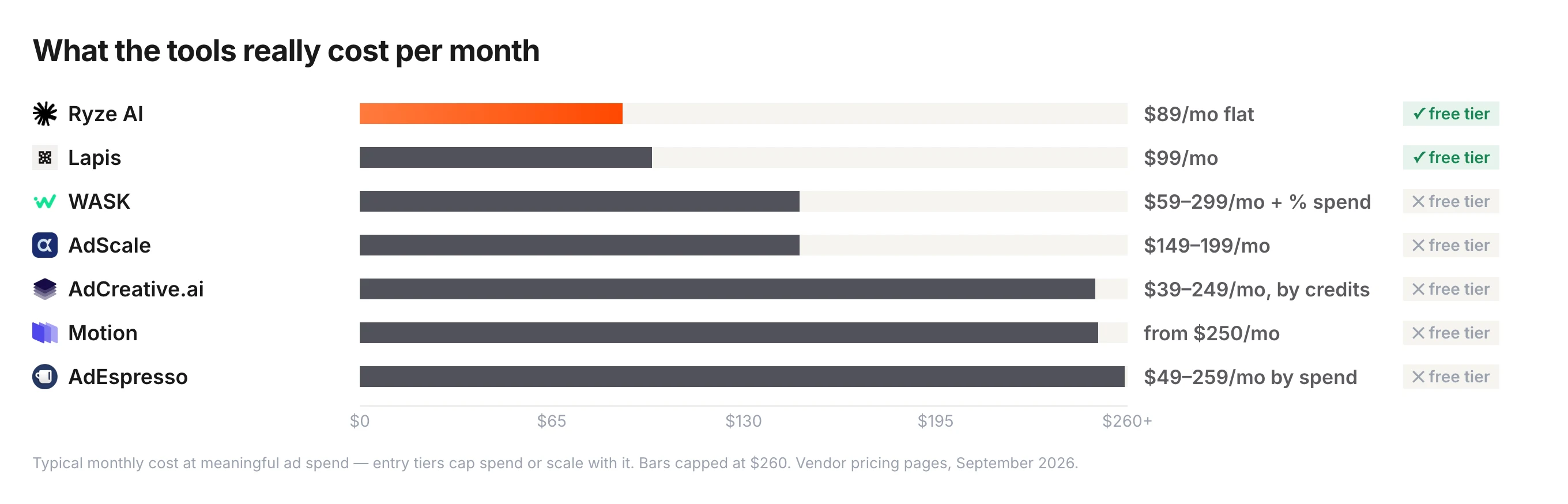
Sticker prices mislead in this category — WASK prices as a percentage of ad spend, AdEspresso caps spend on its entry tier, and creative tools meter credits — so the realistic monthly cost at meaningful spend runs higher. Bars capped at $260 for scale. Ryze AI is the only flat fee.
The pricing models differ more than the prices. WASK scales with the ad spend under management; AdEspresso caps spend at $1,000 on its $49 tier, so a growing account is pushed to Plus at $149 within weeks; Lapis and AdCreative.ai run out of credits at volume; Motion's Starter covers $50K in spend and goes custom above. Ryze AI charges the same flat $89 at any spend. At $50K/month, flat versus spend-scaled pricing is typically a $300–$1,000/month difference before you count a single feature.
What makes the best meta ads automation tools for 2026? Feature-by-feature
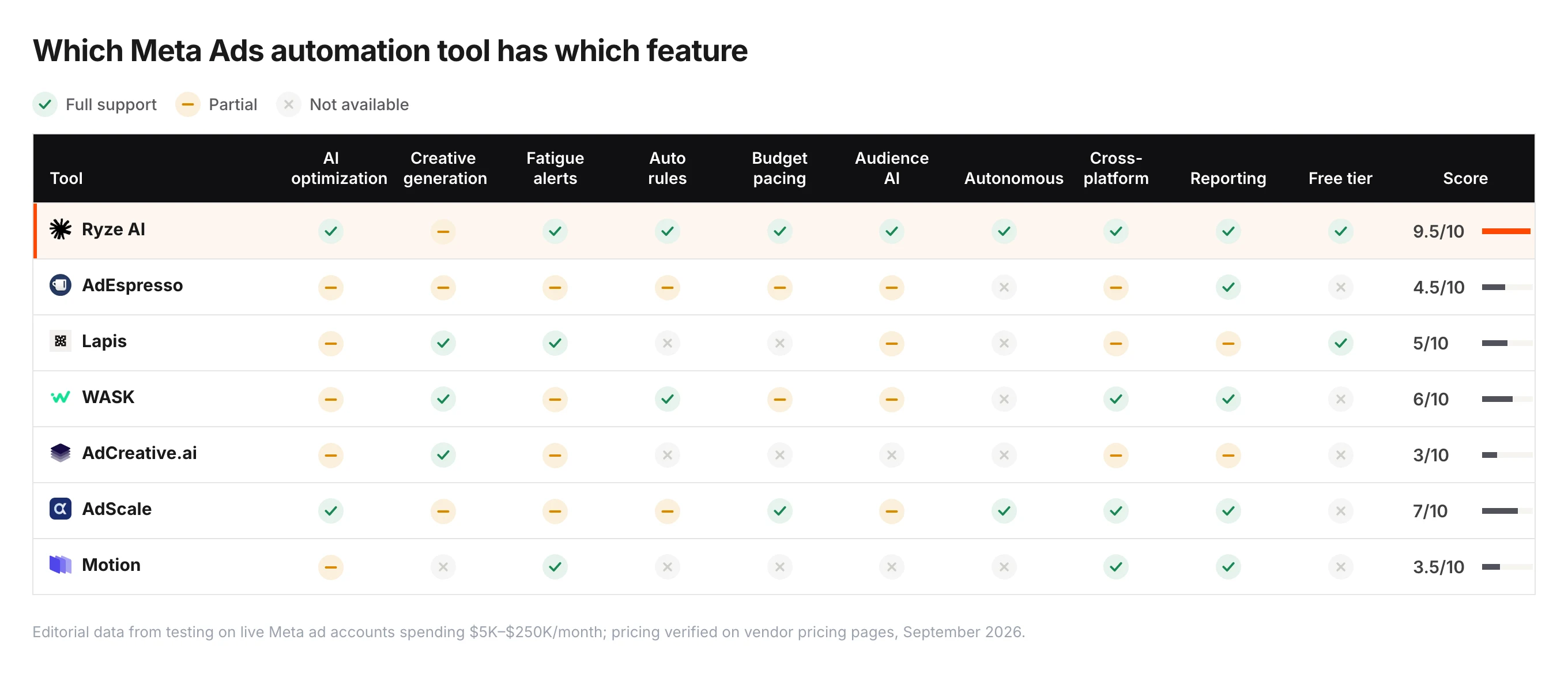
Green check = full support, amber dash = partial, gray cross = not available. The score counts full features as 1 and partial as 0.5. Five capabilities separate the field in 2026: creative-fatigue detection, budget pacing, audience AI, cross-platform coverage, and whether the tool executes on its own.
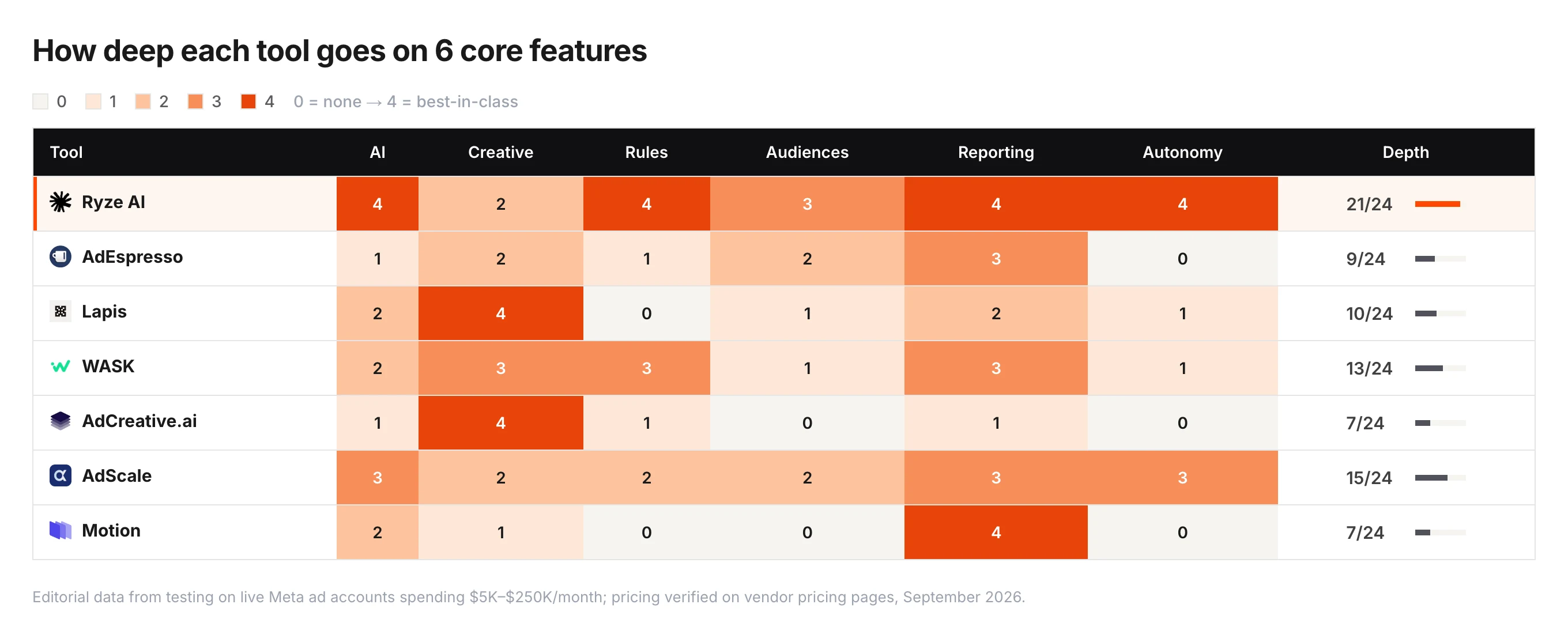
Feature depth at a glance
The market, mapped
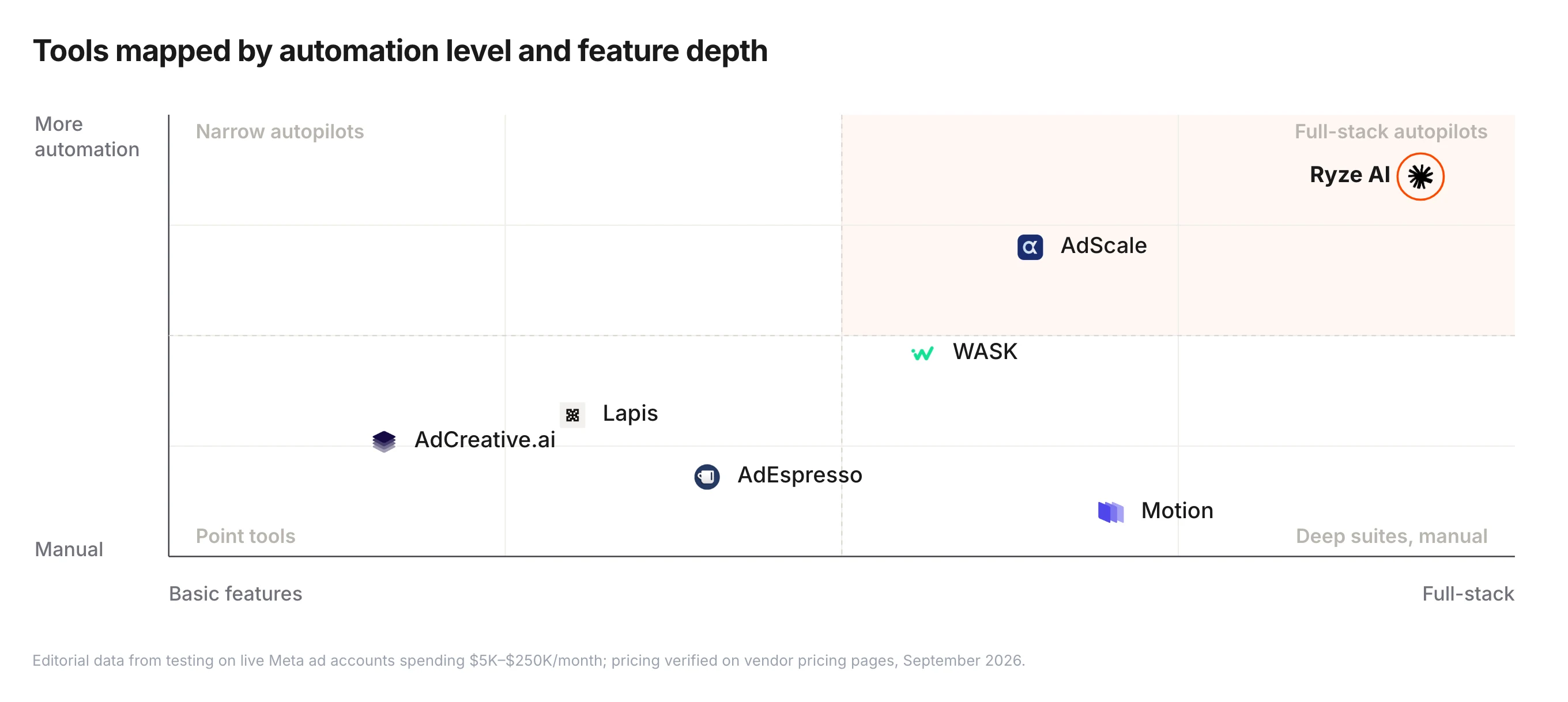
Two axes explain most of the difference between these tools: how much each one automates on its own, and how much of the Meta stack — bidding, budget, creative, audiences, reporting — it covers.
The top-right corner is where hands-off Meta management lives — tools that both decide and act across the whole account. AdScale automates a lot for a store but only from the catalog; the creative tools generate and hand you the launch button; Motion explains results after the fact. The bottom half is tools that inform a human who still does the work.
Complete breakdown: Top 15 meta ads automation tools 2026
Component scores weight features ×3, automation ×3, value ×2 and ease ×2 — the full breakdown is in how we tested. The final editorial score also weights autonomous execution, the ranking axis of this guide. Every tool below is real, buyable today, and priced from its public pricing page as of September 3, 2026. The top seven get full reviews; ranks 8–15 follow in brief.
1
Ryze AI
Best overall — fully autonomous Meta optimization
9.4/10
★★★★★
Editorial score
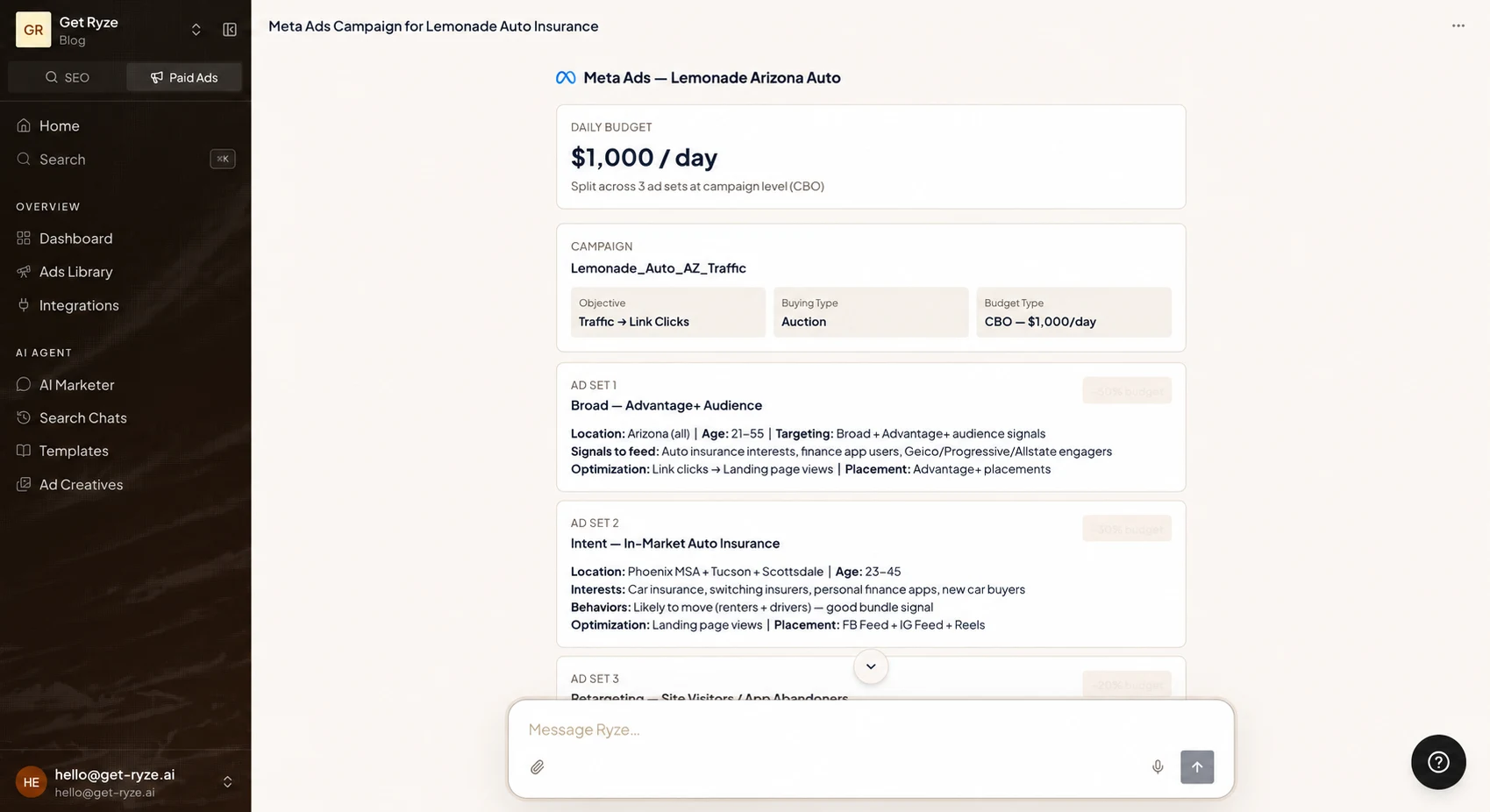
Ryze AI is not a rule builder — it is an autonomous agent that manages Meta Ads 24/7: shifting budget from losing ad sets to winners, pausing creative as frequency climbs and CTR drops, refining audiences, adjusting bids on real conversion data, and flagging anomalies before they drain spend. The Meta Ads changes it makes on its own are documented change type by change type, and approval settings can gate what runs unattended. Unlike every rule engine in this guide there is nothing to configure: connect the account, set the goal, review the log. In our testing it delivered the fastest time-to-value in the roundup — first budget moves within hours of connecting, and users average 3.8x ROAS within six weeks per internal data. Flat $89/month at any spend level, covering Meta, Google, TikTok, LinkedIn and more; used by 2,000+ marketers managing $500M+ in ad spend.
Ryze AI's autopilot view: every optimization it makes to a Meta account, logged with impact — no rules to write.
Pricing
$89/month flat — never a % of ad spend
Best for
Brands and agencies wanting hands-off Meta management
Automation type
Fully autonomous, approvals optional
Pros:
✓Truly autonomous — executes, not just alerts
✓No rules to write or maintain
✓Flat pricing at any spend, 7 platforms
✓Fastest time-to-value in our test
Cons:
−Less granular manual control than a rule engine
−7–14 day learning period on a new account
2
AdEspresso by Hootsuite
Best A/B testing for beginners
8.3/10
★★★★★
Editorial score
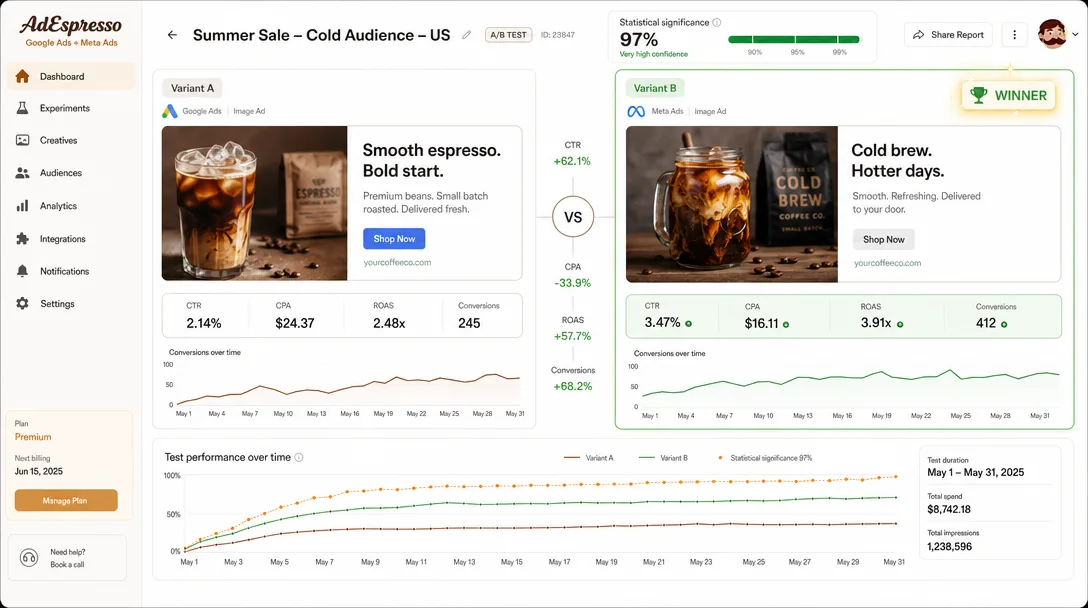
AdEspresso has taught a generation of marketers how to split-test on Facebook: upload three images and three headlines and it builds every combination, runs the test and tells you which variant won and why, with automatic optimization rules on top. The interface assumes no prior experience, the guides are excellent, and it covers Google too. The limits show as you grow — Starter at $49/month caps ad spend at $1,000, Plus is $149 and Enterprise $259 — and the automation is basic next to an autopilot: it optimizes within a test, not across an account. Best for beginners and small teams building a testing habit before they need real automation.
AdEspresso turns a few images and headlines into a full grid of test variants, then reports which combination wins.
Beginners and teams focused on testing methodology
Automation type
AI-assisted — testing
Pros:
✓Easiest A/B testing setup on Meta
✓Great onboarding and education
✓Covers Google Ads too
Cons:
−$1K spend cap on the entry tier
−Basic automation beyond testing
−Outgrown quickly
3
Lapis
Best for AI creative with performance forecasts
8.1/10
★★★★★
Editorial score
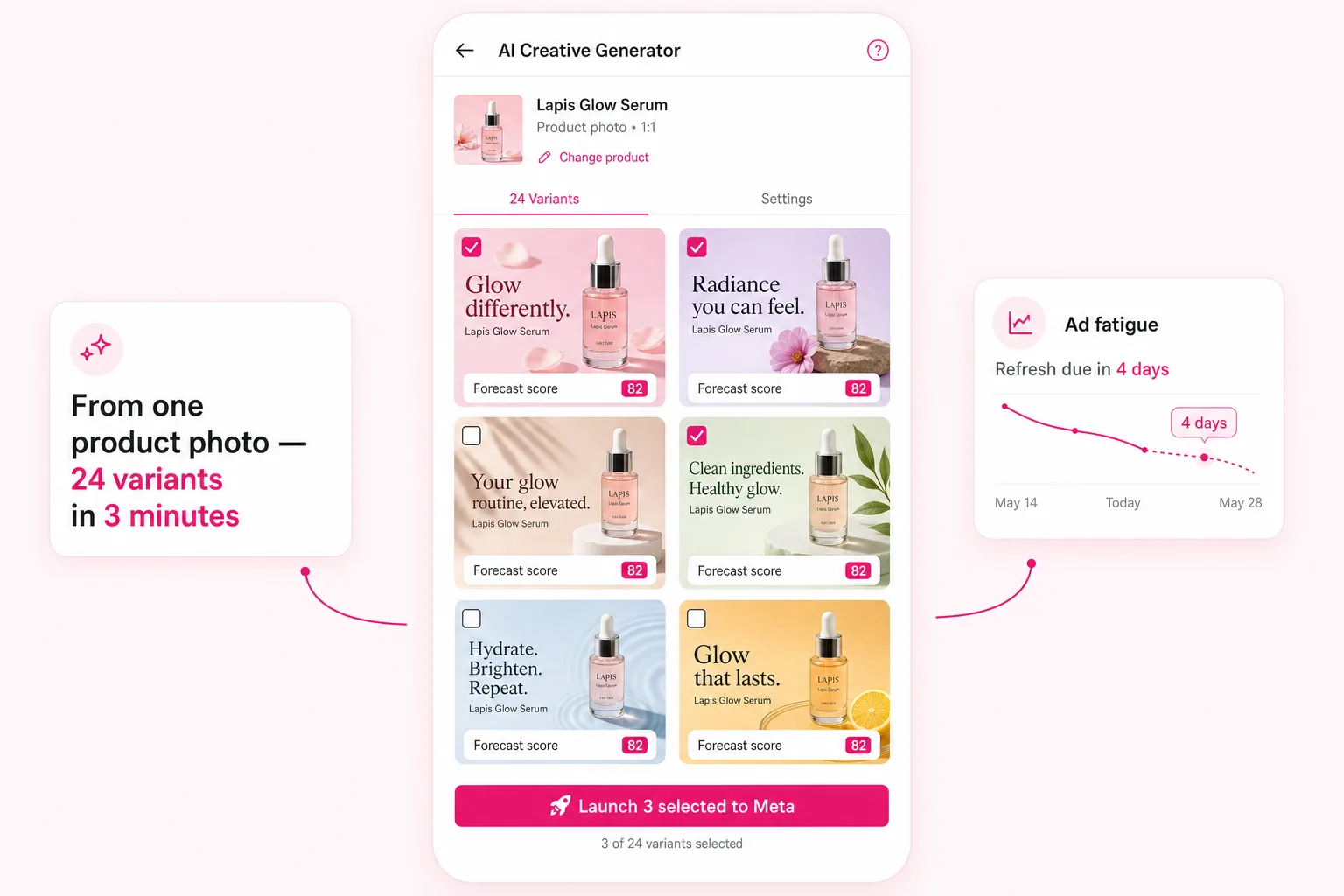
Lapis attacks the biggest Meta performance killer — creative fatigue — from the supply side. Feed it a product and it generates on-brand static and video variants, scores each with a pre-launch performance forecast, and pairs winners with matched landing pages, so you launch fresh creative before the current set dies rather than after. It is not an account manager: no bidding, no budget rules, minimal reporting. Basic is $99/month for Meta with 25 creative credits, with a no-card trial; Pro at $599 adds Google. The best complement to an execution tool for brands whose testing budget goes mostly to finding out which creative works.
Lapis attacks fatigue from the supply side: new scored variants before the old ones decay.
Pricing
$99/mo Basic (25 credits), $599/mo Pro · no-card trial
Best for
Brands that burn budget testing creatives
Automation type
Creative automation
Pros:
✓Pre-launch performance forecasts
✓Fast on-brand variant generation
✓Free trial without a card
Cons:
−No bidding, budget or rule automation
−Credits run out fast at volume
4
WASK
Best all-in-one rules, creative and reporting
7.9/10
★★★★★
Editorial score
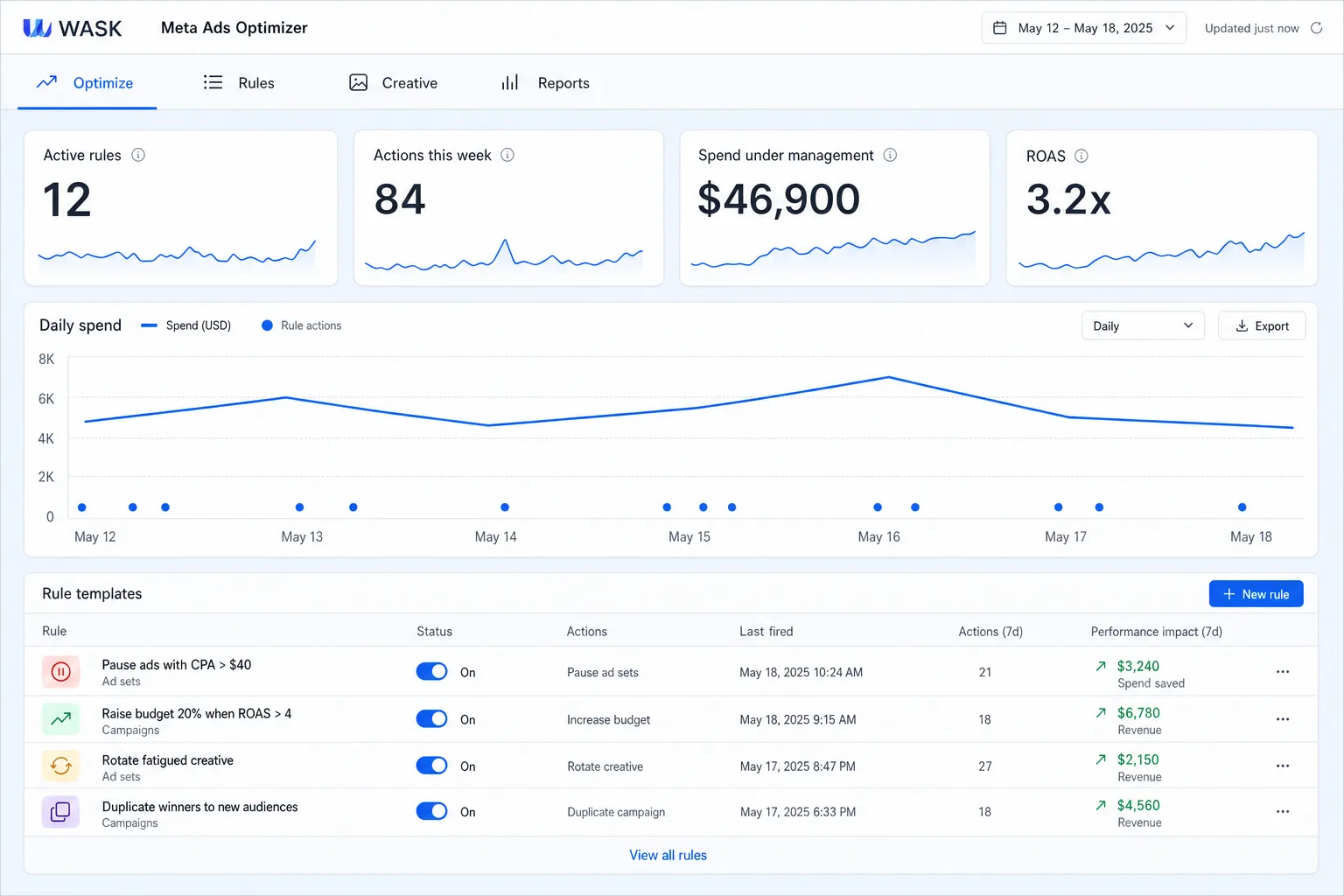
WASK bundles what most teams otherwise buy separately: a rule-based optimization module with 1,000+ templates, an AI creative module for generating and redesigning ads, and a performance dashboard across Meta and Google. For a small team that wants to see, fix and design in one place it is the practical middle ground between a testing tool and an autopilot. Pricing is a percentage of ad spend in tiers from $2.5K to $100K+ a month — roughly $59/month at the low end — with a 7-day free trial, which means the bill grows with the account. The rules still need designing, and the AI is assistive: WASK will suggest and template, not decide.
WASK bundles rules, creative and reporting; you still design the rules.
Pricing
% of ad spend, from ~$59/mo · 7-day trial
Best for
Small teams wanting rules, creative and reporting together
Automation type
Rule-based + AI-assisted creative
Pros:
✓Rules, creative and reporting in one tool
✓1,000+ optimization templates
✓Meta and Google in one dashboard
Cons:
−Priced as a % of spend
−Rules still yours to design
−Suggests rather than decides
Ryze AI — Autonomous Marketing
Stop writing rules for your Meta Ads — let AI run them 24/7
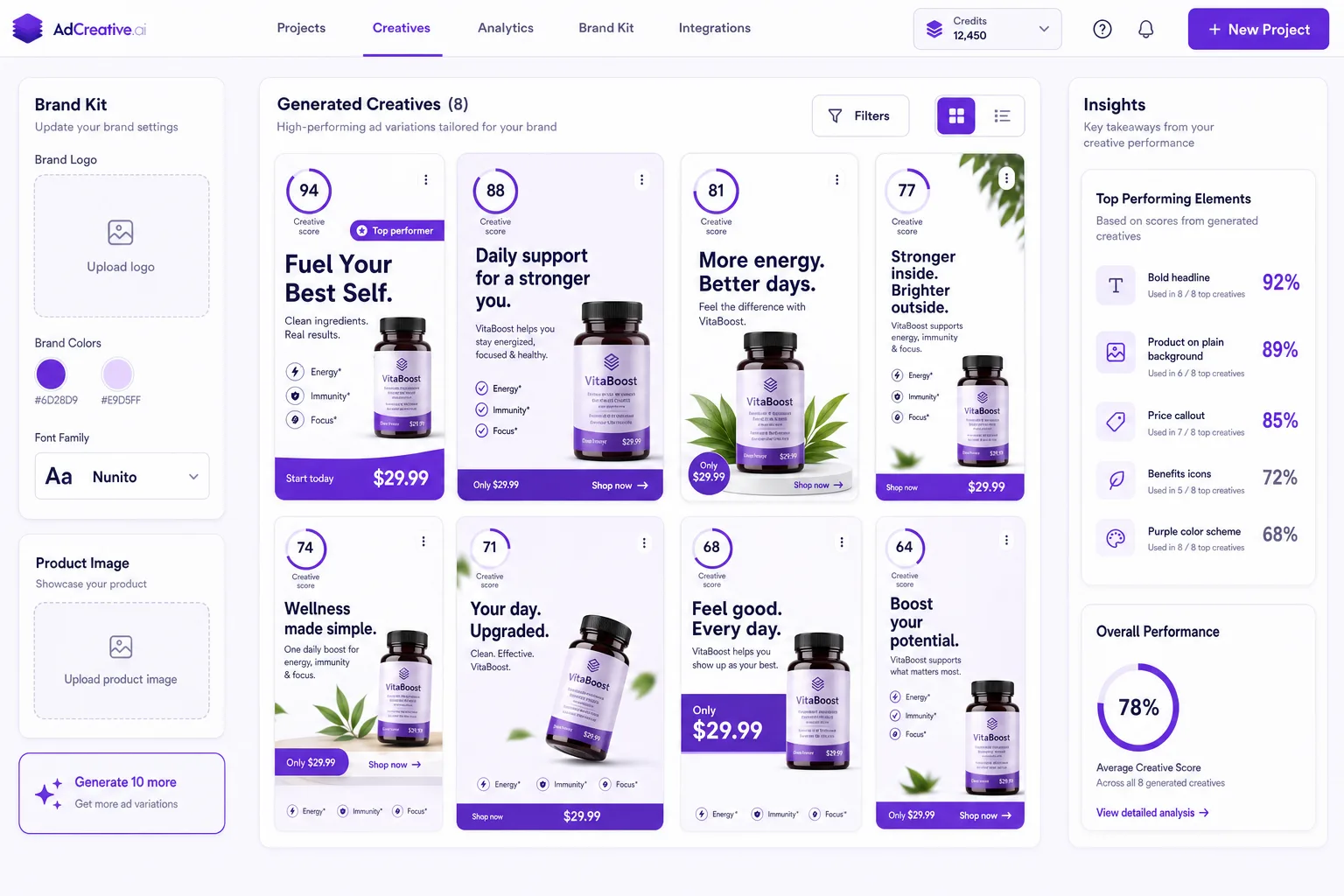
AdCreative.ai is the volume play for creative: banners, videos, product photoshoots and copy generated without a designer, scored by a Creative Scoring AI that predicts which variants will perform before you spend, with competitor analysis on the side. It connects directly to Meta and Google accounts on all paid tiers so approved creative can be pushed into campaigns. Starter is $39/month with 10 credits and a 7-day trial; higher tiers add 50–100+ credits. It is a creative engine, not an optimizer — nothing here manages bids, budgets or fatigue after launch — and credits meter output, so a store refreshing weekly outgrows Starter quickly. The cheapest way in this list to stop running out of ads.
AdCreative.ai is volume creative with a score attached; pair it with a tool that runs the campaigns.
Pricing
from $39/mo (10 credits) · 7-day trial
Best for
Teams that need fresh creative every week without a designer
Automation type
Creative automation
Pros:
✓Creative scoring before you spend
✓Cheapest paid entry here
✓Direct Meta and Google integrations
Cons:
−No optimization after launch
−Credits meter output
−Quality depends on source imagery
6
AdScale
Best catalog-driven ad automation for ecommerce
7.5/10
★★★★★
Editorial score
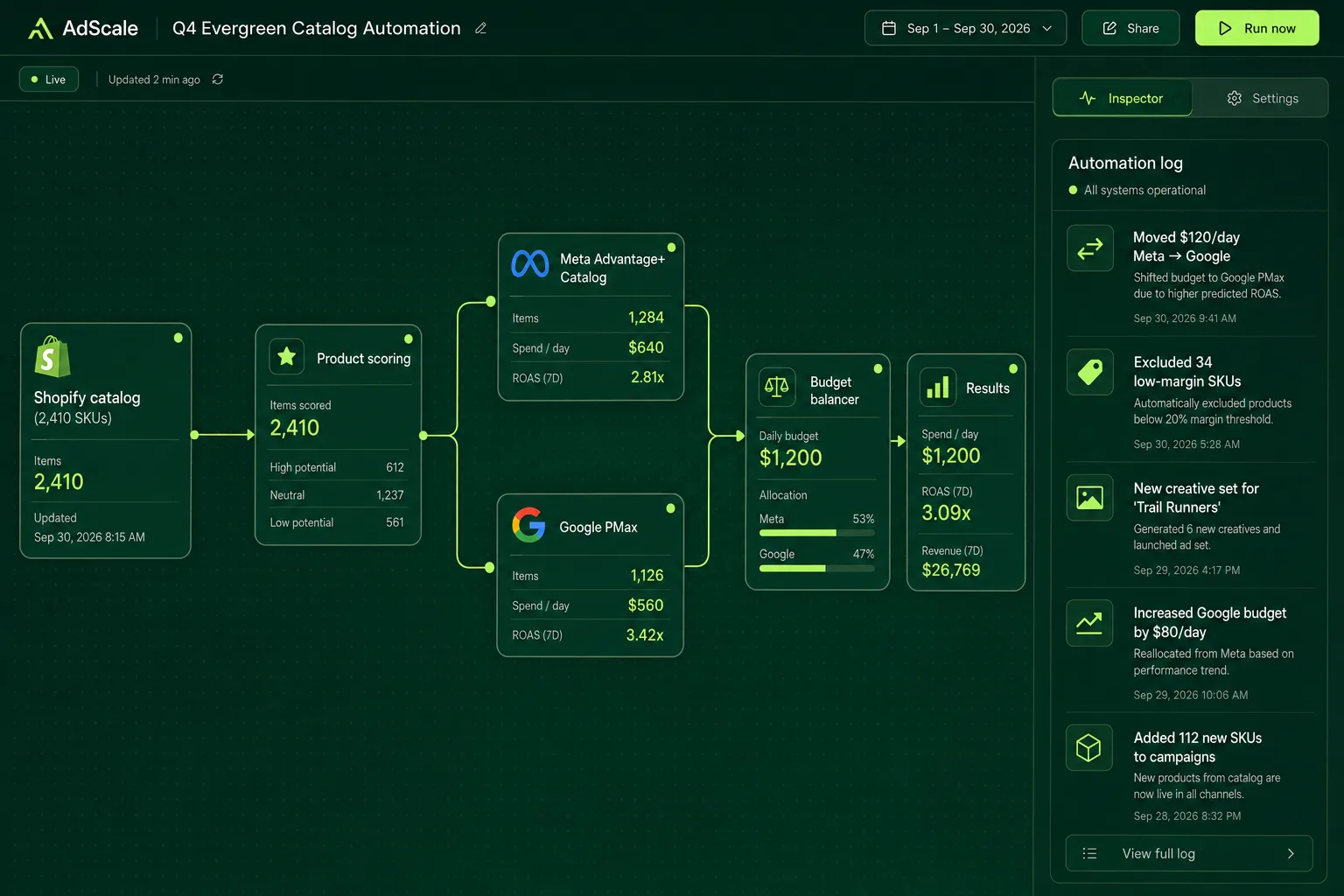
AdScale connects to a Shopify or ecommerce catalog and builds, launches and manages Google Search, Performance Max and Meta campaigns from it — product-level bids, budget shifts between campaigns, creative generated from the feed, and 24/7 AI optimization — which makes it the strongest pure ads automation for a store owner who never wants to open Ads Manager. Basic is $149/month for up to $1,000 in monthly ad spend, Growth $199 for up to $2,000 with reporting and attribution modules, and a Starters plan at $490/year for very small stores, all with a 14-day trial. The scope is the limit: it is built for catalogs, spend tiers cap the entry plans, and controls are coarser than a rule engine.
AdScale builds campaigns from the catalog and moves money between Meta and Google on its own.
Pricing
Basic $149/mo · Growth $199/mo · 14-day trial
Best for
Ecommerce stores that want campaigns built from the catalog
Automation type
AI-assisted autopilot (ecommerce)
Pros:
✓Builds and runs Search, PMax and Meta from the feed
✓Genuine execution, not suggestions
✓Shopify-native
Cons:
−Ecommerce only
−Spend caps on entry plans
−Coarser controls than a rule engine
7
Motion
Best creative analytics for paid-social teams
7.2/10
★★★★★
Editorial score
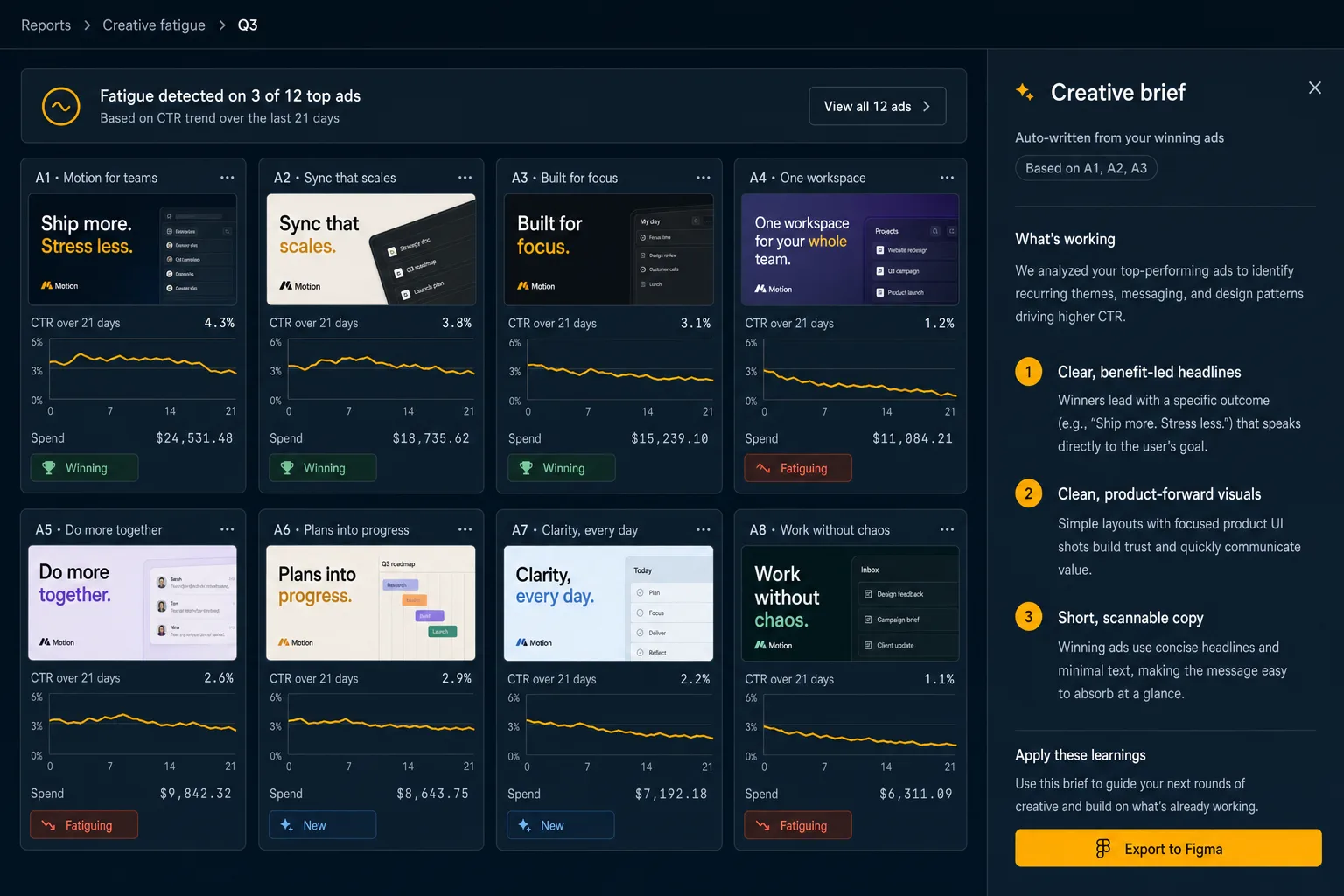
Motion is the creative analytics platform paid-social teams use to connect ad-account performance to the creative decisions behind each ad — hooks, formats, messaging angles, talent — with AI tagging, an ad leaderboard, fatigue prediction and competitor research across Meta, TikTok, YouTube and LinkedIn. It does not run anything: Motion tells you which creative worked and why, and your team acts. Starter is $250/month for up to $50K in monthly ad spend with unlimited seats and accounts and a 14-day trial; Pro and Growth are custom above that. Worth it once creative volume is the lever and you need evidence for the next brief; expensive as a first tool.
Motion is the analytics layer for creative teams: it tells you what to make next, not what to pause.
Teams producing creative at volume who need to know what worked
Automation type
AI-assisted — analytics
Pros:
✓Creative-level attribution across four platforms
✓Fatigue prediction and AI tagging
✓Unlimited seats and accounts
Cons:
−Analysis only — executes nothing
−$250 entry
−Custom pricing above $50K spend
Ranks 8–15:Zalster (7.0) — simple Swedish bid and budget automation from €49/mo, Meta only. Socioh (6.9) — branded dynamic catalog ads for Shopify and WooCommerce stores, $99/mo. Adzooma (6.8) — free cross-platform monitoring with an account health score, paid from $69/mo, surface-level on Meta. Hunch (6.7) — feed-based creative automation for social at custom pricing. Marpipe (6.6) — automated catalog ad design and multivariate testing. Pencil (6.5) — AI creative generation with performance prediction. Superads (6.4) — AI creative reporting for Meta and TikTok. Adriel (6.3) — cross-channel dashboards with automated rules.
Get a free instant audit
Get a free, instant read on your paid ads or SEO — and fix it right away.
Paid ads audit
Catch wasted spend & broad-match leaks
Find account structure gaps
Rank your quickest wins
Spot PMax & brand-search overlap
Check conversion-tracking health
Benchmark CPC vs your industry
Catch wasted spend & broad-match leaks
Find account structure gaps
Rank your quickest wins
Spot PMax & brand-search overlap
Check conversion-tracking health
Benchmark CPC vs your industry
Free · no credit card · instant
SEO audit
Find keyword & ranking gaps
Catch technical SEO issues
Rank your fastest wins
Surface thin & duplicate pages
Check indexing & crawl coverage
Compare backlinks vs competitors
Find keyword & ranking gaps
Catch technical SEO issues
Rank your fastest wins
Surface thin & duplicate pages
Check indexing & crawl coverage
Compare backlinks vs competitors
Free · no credit card · instant
Which automation types work best for Meta campaigns?
Meta ads automation tools use four distinct approaches: rule-based logic, AI-assisted optimization, creative automation, and fully autonomous AI. Each fits a different team, and most bad tool choices come from buying the wrong type rather than the wrong brand.
Type
What it does
You still do
Tools in this guide
Rule-based
Executes if-then rules on a schedule — pause, scale, alert
Design, test and maintain every rule
WASK, Zalster, Adriel
AI-assisted
Suggests bids, tests or audiences; you approve
Review and apply each change
AdEspresso, AdScale (partly), Motion
Creative automation
Generates and scores creative; bulk-launches
Pick winners, manage the account
Lapis, AdCreative.ai, Pencil, Marpipe, Hunch
Fully autonomous
Decides and executes 24/7 — bids, budgets, creative rotation, audiences
Set goals and guardrails, review the log
Ryze AI
Rule-based tools are precise but brittle: rules break when campaign structures change and a mature account needs dozens of them. AI-assisted and creative tools cut the analysis or the design time but still leave you as the operator. Fully autonomous management is the only type that removes the daily check-in; it trades granular control for time, which is why approval controls matter for the first weeks. For the Meta-specific decisions — attribution windows, rising cost per lead — the type you pick decides whether a human or the tool responds.
How to choose the right automation tool for your business?
Selecting from 15 tools comes down to three variables: your monthly ad spend, whether creative or optimization is your bottleneck, and whether Meta is your only channel.
Monthly ad spend: $5K–$25K
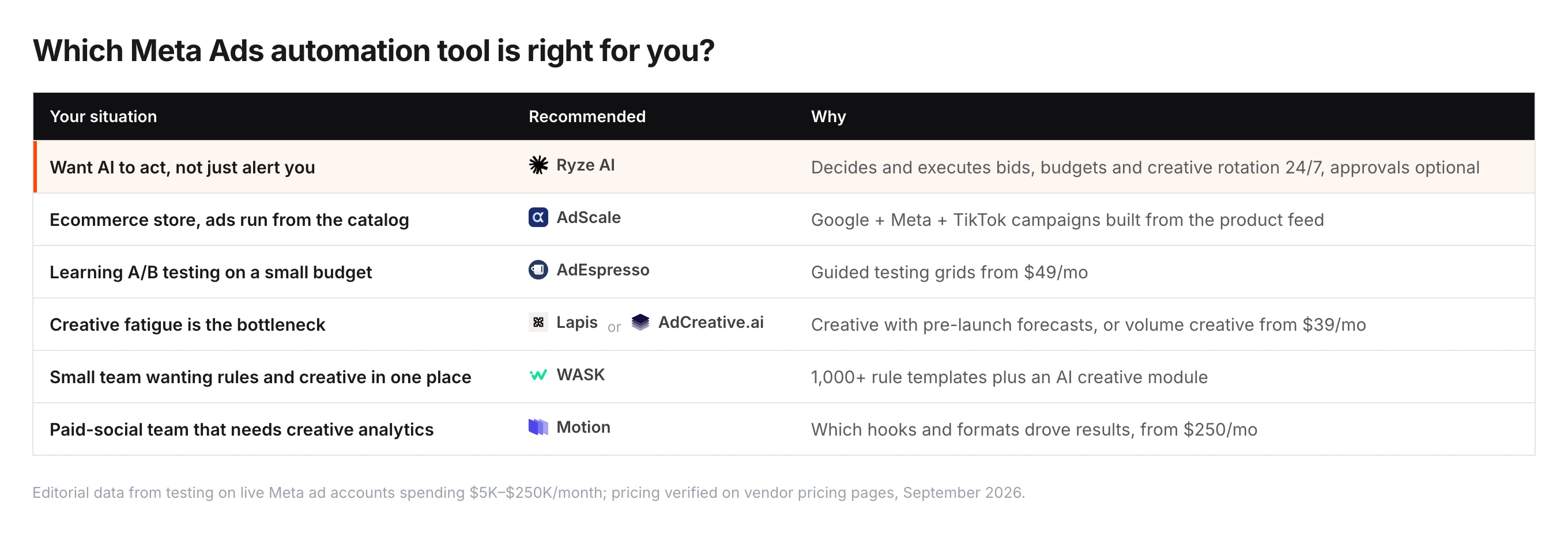
Ryze AI for hands-off growth at a flat $89, AdEspresso if you want to learn testing with guided tooling, AdCreative.ai or Lapis if creative is the constraint. Skip Motion at this level — its $250 Starter is priced for teams already producing creative at volume.
Monthly ad spend: $25K–$100K
At this scale automation ROI justifies premium tools and manual management becomes the bottleneck. Ryze AI for multi-platform scaling with a flat fee, WASK if your team wants to encode a rulebook and generate creative in one place, AdScale if you run a store and want campaigns built from the catalog. Spend-scaled tools like WASK start to cost more than the flat options here.
Monthly ad spend: $100K+ and team experience
Motion earns its place once creative volume is the lever and you need to know which hooks and formats drove results; Ryze AI when you want autonomous optimization across channels without the headcount. Beginners should start with Ryze AI (no setup), AdEspresso or WASK; advanced buyers get the most from pairing an autopilot with a creative engine. If you also run Google, pick a tool that covers both — see the Google Ads automation tool guide and Claude skills for Meta Ads for the analysis layer.
Sarah K.
Paid Media Manager E-commerce Agency
★★★★★
“
We tested six automation tools before settling on Ryze AI. The autonomous optimization actually works — client ROAS went from 2.8x to 4.7x without any rule setup or daily management.”
Final verdict: which Meta ads automation tool should you pick?
1Ryze AI — Fully autonomous Meta management9.4/10
2AdEspresso — Beginner A/B testing8.3/10
3Lapis — AI creative with forecasts8.1/10
4WASK — All-in-one rules and creative7.9/10
5AdCreative.ai — Volume creative with scoring7.7/10
6AdScale — Catalog-driven ads for ecommerce7.5/10
7Motion — Creative analytics for social teams7.2/10
After testing all 15 tools on live accounts, here is the bottom line: Ryze AI is the best overall pick for most advertisers. Its autonomous agent, flat $89/month pricing and 3.8x average ROAS within six weeks (per internal Ryze data) make it the strongest value at any budget — and the Meta Ads changes it makes on its own are documented change type by change type.
AdEspresso is the best choice for learning testing on a small budget. Lapis and AdCreative.ai win when creative fatigue is the problem. WASK is the best all-in-one for a small team and AdScale the best store autopilot. Motion is the creative-analytics layer for teams producing at volume. If Meta is one of several channels, start with the top AI tools for Meta Ads management and the Meta ads autopilot tools comparison.
The tools that win in 2026 are the ones shifting from “rule builder with alerts” to “agent that executes.” Start with the tool that matches your biggest bottleneck, measure ROAS and hours saved over 30 days against your manual baseline, and scale from there.
Why Meta ads automation matters in 2026
Meta CPMs rose sharply through 2025 and creative fatigue now sets in within 3–7 days of launch. Manual management — checking frequency, rotating creative, rebalancing budgets across ad sets — costs agencies $3,500–8,000 per month per account in labor, while the tools in this guide do the repetitive layer for under $500.
Three capabilities separate 2026 tools from 2023 ones. Creative-fatigue detection — monitoring CTR trend, frequency and relevance to flag a dying ad before it drains budget — is the highest-impact automation on Meta. Attribution handling — first-party tracking, Conversions API and modeling — decides whether a tool optimizes on real signal after iOS privacy changes. Cross-platform coordination matters because the Meta and Google auctions compete for the same buyers; single-platform tools create optimization silos.
Our evaluation criteria follow from that: automation depth (does it act or alert?), creative tooling, pricing transparency, time-to-value and cross-platform coverage. To judge any tool's results against your sector's norms, keep the Meta ads cost benchmarks by industry handy.
How did we test meta ads automation tools for this 2026 guide?
How we tested — and who is writing this
What we tested: 15 tools evaluated against live Meta ad accounts spending $5K–$250K per month across ecommerce, lead generation and SaaS, with pricing and feature sets re-checked September 2026.
What we did not test: custom-priced enterprise tiers (Motion Growth, Hunch) beyond demos and public documentation, and results outside the test window.
Pricing: verified against each vendor's public pricing page on September 3, 2026. Ryze AI's Paid Ads Autopilot is $89/month flat.
Disclosure: this guide is published by Ryze AI and Ryze AI appears in the ranking. We mark it as our pick and show the comparison data so you can judge every tool independently.
Each tool was rated 0–5 on four criteria from our testing: feature depth (×3), automation depth (×3), value for money (×2), and ease of use (×2), for a component total out of 50.
Tool
Features ×3
Automation ×3
Value ×2
Ease ×2
Total / 50
Ryze AI
5
5
5
4
48
AdEspresso
3
2
4
5
33
Lapis
3
2
4
4
31
WASK
3
3
3
4
32
AdCreative.ai
2
1
5
4
27
AdScale
4
4
3
4
38
Motion
3
1
2
4
24
The component totals are not the ranking by themselves. The final editorial score (shown on each tool card) also weights creative-fatigue handling and fit for a typical Meta advertiser — which is why an ecommerce-only autopilot with a strong component total does not outrank the tools most readers can use, and why an analytics tool with a low total still earns a place.
What we would not recommend
A few tools still show up in older best-of lists and should not be on a 2026 shortlist. Pattern89 was acquired by Shutterstock in 2021 and the product is gone. Qwaya has shut down. Trapica is no longer sold as a standalone product. Generic AI copywriters such as Jasper or Copy.ai are marketed as ads automation but have no account connection and execute nothing, so they belong in a creative stack, not in this ranking. We also declined to rank tools whose Trustpilot record shows a pattern of post-trial billing complaints; the tools above all passed that check.
Frequently asked questions
What are the best meta ads automation tools for 2026?
Ryze AI leads at 9.4/10 as the only fully autonomous option — it decides and executes bid, budget, creative and audience changes 24/7 at $89/month flat. AdEspresso is the easiest way to learn A/B testing, Lapis and AdCreative.ai the creative-first picks, WASK the all-in-one for small teams, AdScale the store autopilot, and Motion the creative-analytics layer. The choice depends on spend, whether creative or optimization is the bottleneck, and whether Meta is your only channel.
How much do meta ads automation tools cost in 2026?
From free tiers (Adzooma, Lapis trial) to custom enterprise pricing (Motion above $50K spend, Hunch). Mid-market tools run $39–$250/month: AdCreative.ai from $39, AdEspresso $49–259, WASK from about $59 as a percentage of spend, Lapis $99, AdScale $149–199, Motion from $250. Ryze AI is $89/month flat at any spend level.
Do automation tools work better than manual Meta ads management?
Yes, on the repetitive layer. Tools catch creative fatigue within hours instead of at the weekly check-in, rebalance budgets around the clock and never miss an anomaly at 3am. In our testing, autonomous management cut weekly management time by 85–95% and rule engines by 40–60%. Strategy, offers and creative direction still need a human.
What is the difference between AI and rule-based automation?
Rule-based tools like WASK, Zalster and Adriel execute if-then logic you configure: precise, but every rule is yours to design and maintain, and rules break when campaign structures change. AI tools learn from performance data; AI-assisted tools like AdEspresso and Motion suggest and you act, creative tools like Lapis and AdCreative.ai generate and you launch, while autonomous tools like Ryze AI decide and execute with approval controls optional.
Can automation tools handle iOS attribution challenges?
The good ones combine first-party tracking, Meta's Conversions API and statistical modeling so they optimize on real signal rather than degraded pixel data. Before buying, check whether the tool reads Conversions API events and how it treats the 7-day-click versus 1-day-view attribution settings — our Meta ads attribution settings guide covers the trade-offs.
Should I automate creative refresh or budget optimization first?
Creative-fatigue detection first — fatigued creative wastes 20–30% of Meta budgets and sets in within 3–7 days. Budget pacing and reallocation second, then audience testing. Ryze AI does all three; Lapis and AdCreative.ai cover creative supply; WASK and AdScale cover budget and bids; Motion tells you which creative to make next.
Which tool is best for creative fatigue on Meta?
Depends on whether you need supply or diagnosis. Lapis and AdCreative.ai generate fresh variants with pre-launch scoring so you can rotate before an ad dies. Motion diagnoses which hooks and formats are fatiguing and why. Ryze AI detects fatigue on the live account and pauses or rotates on its own. Most teams at scale run one creative engine beside one executor.
Are Meta's native Advantage+ and Automated Rules enough?
As a free baseline, yes; as automation, no. Advantage+ targets well but reports as a black box and cannot see your other channels. Automated Rules check hourly, cover only pause, budget and bid conditions, and have no creative intelligence. Most advertisers run native tools alongside a third-party tool rather than instead of one.
Is autonomous AI safe to run on a real Meta ad account?
Yes, with controls. Ryze AI ships approval mode — every proposed change can be held for review before it touches the account — plus a change log to audit what the agent did and why. Expect a 7–14 day learning period before autonomous changes hit their stride, and keep approvals on for the first weeks if your account is large.
Can one tool automate Meta Ads and Google Ads together?
Yes — Ryze AI, WASK, AdScale and Adzooma all cover both, and cross-platform management matters because the two auctions compete for the same buyers. If search is your bigger channel, start with our Google Ads automation tool guide and pick a tool that covers both from one subscription.
Which automation tool is best for a Shopify store?
AdScale if you want Google and Meta campaigns built and run from the catalog without opening Ads Manager; Socioh if branded catalog creative is the gap; Ryze AI if you want the whole account run autonomously across channels at a flat fee. Our AI marketing tools for Shopify guide compares the store-side stack in full.
Do Meta ads automation tools replace a media buyer?
No. They replace the repetitive layer: frequency checks, budget shifts, creative rotation, reporting. Strategy, offer design and creative direction stay human. Teams using autonomous tools typically redeploy buyer hours to creative testing and landing pages — the work that compounds — rather than cutting headcount.






 Ryze AI
 AdEspresso
 Lapis
Lapis WASK
WASK AdCreative.ai
 AdScale
 Motion